
Discussion
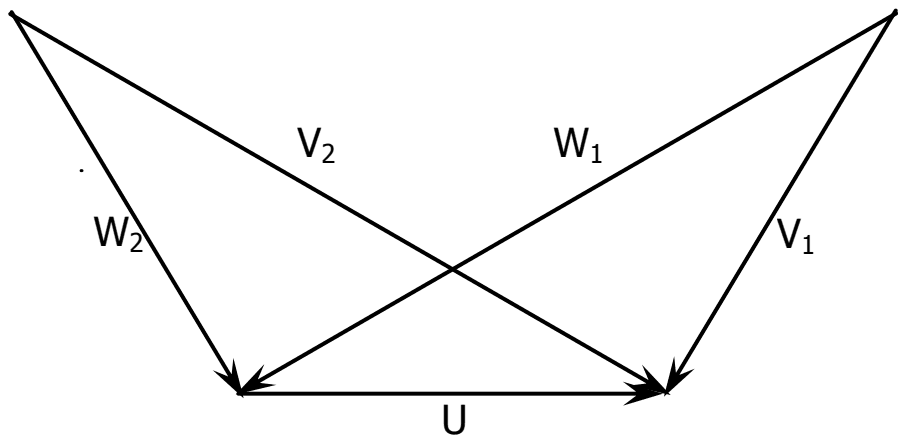
The velocity triangles at the inlet and exit of the rotor of a turbomachine are shown. V denotes the absolute velocity of the fluid, W denotes the relative velocity of the fluid and U denotes the blade velocity. Subscripts 1 and 2 refer to inlet and outlet respectively. If V2 = W1 and V1 = W2, then the degree of reaction is
Answer: C
The degree of reaction is 0.5.
The degree of reaction is the share of the stage's energy change that takes place in the rotor as a change of relative kinetic energy. With the same blade speed U at inlet and exit:
\[ R = \frac{W_2^2-W_1^2}{(V_1^2-V_2^2)+(W_2^2-W_1^2)} \]
Substituting \(W_{2}=V_{1}\) and \(W_{1}=V_{2}\) makes the two brackets equal, so R = 1/2. The velocity triangles are mirror images, the signature of a 50 % reaction stage such as Parsons' turbine.
0 would be an impulse stage (no change in relative speed) and 1 a stage with no change in absolute kinetic energy; 0.25 matches neither condition.
Post your comment
Please log in or register to post a comment.
Examination Categories
- SSC Exams
- Banking Exams
- Teaching Exams
- Civil Services Exams
- Railways Exams
- Engineering Recruitment Exams
- Defence Exams
- State Government Exams
- Police Exams
- Insurance Exams
- Nursing Exams
- Other Government Exams
- NRA CET
- PG Entrance Exams
- Campus Placement
- MBA Entrance Exams
- CUET and UG Entrance
- Judiciary Exams
- Regulatory Body Exams
- Software Development