
Discussion
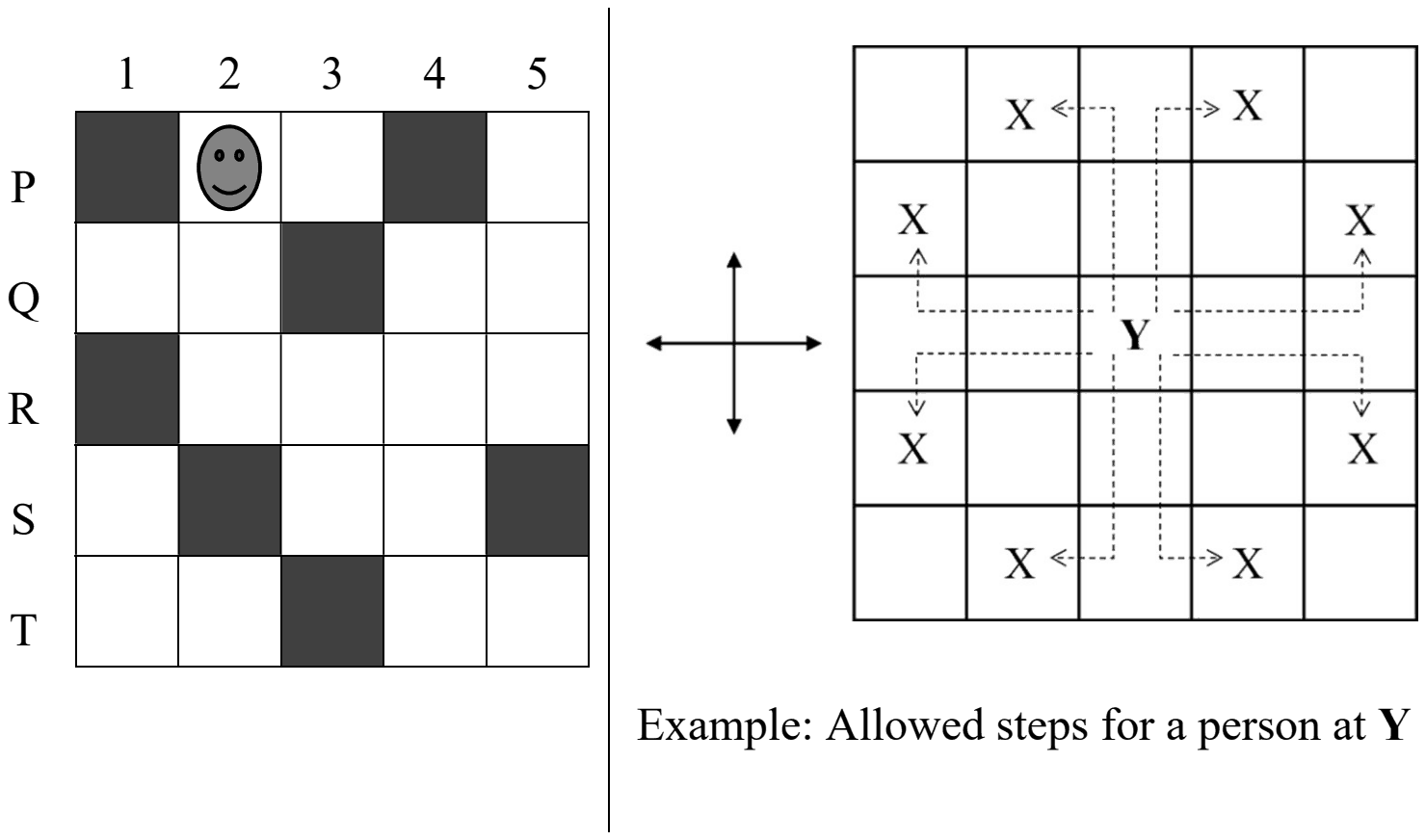
In the square grid shown on the left, a person standing at P2 position is required to move to P5 position.
The only movement allowed for a step involves, “two moves along one direction followed by one move in a perpendicular direction”. The permissible directions for movement are shown as dotted arrows in the right.
For example, a person at a given position Y can move only to the positions marked X on the right.
Without occupying any of the shaded squares at the end of each step, the minimum number of steps required to go from P2 to P5 is
Answer: B
The minimum number of steps is 5.
Each step is a chess knight's move (two squares one way, one square at right angles), and no step may end on a shaded square (P1, P4, Q3, R1, S2, S5, T3). One shortest route is
P2 → Q4 → R2 → P3 → R4 → P5
Every move is a legal knight's move and every square it ends on is unshaded.
Fewer steps are impossible. The target P5 can be entered only from R4, because its other knight neighbour, Q3, is shaded. Working outward from P2, the squares reachable in one step are Q4 and R3; in two steps R2, S3, Q1, Q5, S1, T2 and T4; in three steps P3, S4, T1, Q2, R5 and T5. R4 is first reached on the fourth step, so P5 needs a fifth. That rules out 4, and 6 or 7 are not minimal.
Post your comment
Please log in or register to post a comment.
Examination Categories
- SSC Exams
- Banking Exams
- Teaching Exams
- Civil Services Exams
- Railways Exams
- Engineering Recruitment Exams
- Defence Exams
- State Government Exams
- Police Exams
- Insurance Exams
- Nursing Exams
- Other Government Exams
- NRA CET
- PG Entrance Exams
- Campus Placement
- MBA Entrance Exams
- CUET and UG Entrance
- Judiciary Exams
- Regulatory Body Exams
- Software Development