
Discussion
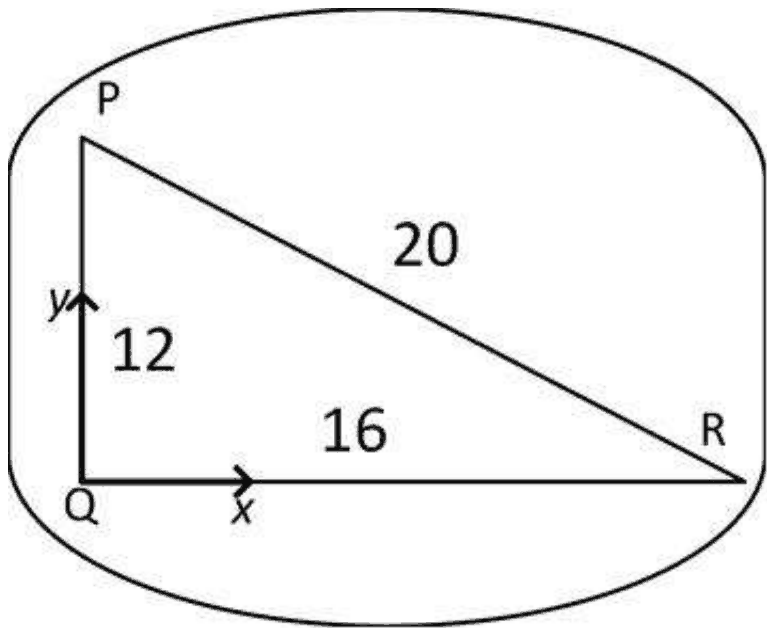
In a rigid body in plane motion, the point R is accelerating with respect to point P at 10∠180° m/s2. If the instantaneous acceleration of point Q is zero, the acceleration (in m/s2) of point R is
Answer: D
The acceleration of R is 8∠217° m/s2.
In plane rigid-body motion, the acceleration of one point relative to another is \(\vec{a}_{B/A} = \vec{\alpha}\times\vec{r}_{AB} - \omega^{2}\vec{r}_{AB}\). Its magnitude is \(|r_{AB}|\sqrt{\alpha^{2}+\omega^{4}}\), and it makes the same fixed angle with \(\vec{r}_{AB}\) for every pair of points.
From P to R the distance is 20 and the direction is that of (16, -12), at -36.87° (323.13°). The given relative acceleration is 10 at 180°, so
\[ \begin{aligned} \sqrt{\alpha^{2}+\omega^{4}} &= 10/20 = 0.5 \\ \text{angle offset} &= 180^\circ - 323.13^\circ = -143.13^\circ \end{aligned} \]
Since Q has zero acceleration, \(\vec{a}_{R} = \vec{a}_{R/Q}\). From Q to R the distance is 16 at 0°, so \(|a_{R}| = 16 \times 0.5 = 8\) at 0° - 143.13° = 216.87°, about 217°.
8∠233° has the right size but the wrong direction, and the options with magnitude 10 simply copy the given relative acceleration.
Post your comment
Please log in or register to post a comment.
Examination Categories
- SSC Exams
- Banking Exams
- Teaching Exams
- Civil Services Exams
- Railways Exams
- Engineering Recruitment Exams
- Defence Exams
- State Government Exams
- Police Exams
- Insurance Exams
- Nursing Exams
- Other Government Exams
- NRA CET
- PG Entrance Exams
- Campus Placement
- MBA Entrance Exams
- CUET and UG Entrance
- Judiciary Exams
- Regulatory Body Exams
- Software Development