
Discussion
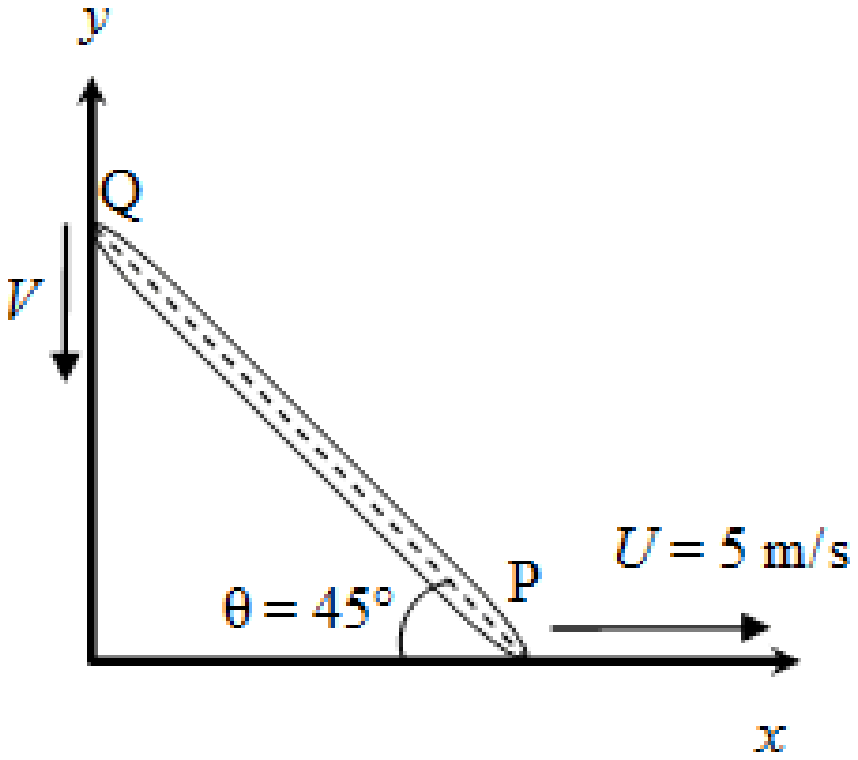
A rigid rod of length 1 m is resting at an angle θ = 45° as shown in the figure. The end P is dragged with a velocity of U = 5 m/s to the right. At the instant shown, the magnitude of the velocity V (in m/s) of point Q as it moves along the wall without losing contact is
Answer: A
The speed of Q is 5 m/s.
Put the corner at the origin, with P at (x, 0) on the floor and Q at (0, y) on the wall. The rod's length fixes \(x^{2} + y^{2} = 1\). Differentiating with respect to time:
\[ \begin{aligned} x\dot{x} + y\dot{y} &= 0 \\ |\dot{y}| &= \frac{x}{y}\,\dot{x} = \cot\theta \times U \end{aligned} \]
At θ = 45°, x = y, so cot θ = 1 and V = U = 5 m/s, directed down the wall.
The same result follows from the instantaneous centre, which lies at the intersection of the normals to the two velocities, equidistant from P and Q when θ = 45°. The rod's length does not affect the speed ratio, and 6, 8 and 10 have no basis in this geometry.
Post your comment
Please log in or register to post a comment.
Examination Categories
- SSC Exams
- Banking Exams
- Teaching Exams
- Civil Services Exams
- Railways Exams
- Engineering Recruitment Exams
- Defence Exams
- State Government Exams
- Police Exams
- Insurance Exams
- Nursing Exams
- Other Government Exams
- NRA CET
- PG Entrance Exams
- Campus Placement
- MBA Entrance Exams
- CUET and UG Entrance
- Judiciary Exams
- Regulatory Body Exams
- Software Development