
Discussion
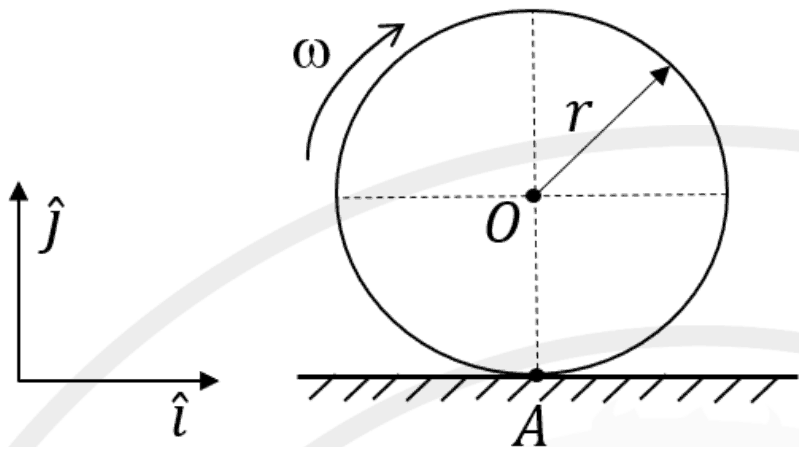
A rigid circular disc of radius \(r\) (in m) is rolling without slipping on a flat surface as shown in the figure below. The angular velocity of the disc is \(\omega\) (in rad \(\text{s}^{-1}\)). The velocities (in m \(\text{s}^{-1}\)) at points \(O\) and \(A\), respectively, are
Answer: A
The velocities are \(r\omega\,\hat{i}\) at O and \(0\,\hat{i}\) at A.
In rolling without slipping, the contact point A has zero velocity, because it does not slide on the ground. The disc turns clockwise, as the arrow shows, so it rolls to the right, in the \(+\hat{i}\) direction.
The centre is a distance \(r\) above the instantaneous centre A, so its speed is \(r\omega\), directed along \(+\hat{i}\). \(-r\omega\,\hat{i}\) would be anticlockwise rolling. The options giving A a velocity of \(\pm r\omega\) contradict the no-slip condition.
Post your comment
Please log in or register to post a comment.
Examination Categories
- SSC Exams
- Banking Exams
- Teaching Exams
- Civil Services Exams
- Railways Exams
- Engineering Recruitment Exams
- Defence Exams
- State Government Exams
- Police Exams
- Insurance Exams
- Nursing Exams
- Other Government Exams
- NRA CET
- PG Entrance Exams
- Campus Placement
- MBA Entrance Exams
- CUET and UG Entrance
- Judiciary Exams
- Regulatory Body Exams
- Software Development