
Discussion
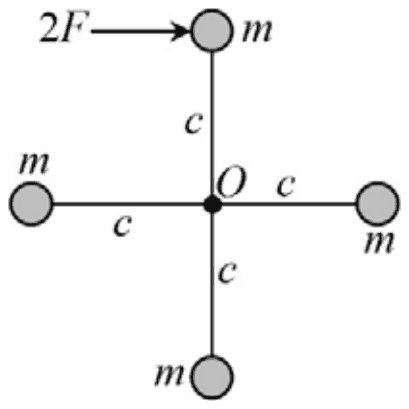
The assembly of four masses connected by rigid mass-less rods is kept on a smooth horizontal floor as shown in the figure. Under the applied force \(2F\), the magnitude of angular acceleration of the assembly at the instant shown is
Answer: B
The angular acceleration is \(\frac{F}{2mc}\).
On a smooth floor the assembly is free. Its centre of mass is at O, and the moment of inertia about O is that of four masses at distance c:
\[ \begin{aligned} I_{O} &= 4mc^{2} \\ \tau_{O} &= 2F \cdot c \\ \alpha &= \frac{2Fc}{4mc^{2}} = \frac{F}{2mc} \end{aligned} \]
The force also accelerates the centre of mass, at \(2F/4m\), but that does not change the rotation about the centre of mass. \(F/(mc)\) uses only two of the masses in the inertia, and \(2F/(3mc)\) and \(F/(3mc)\) do not match the inertia \(4mc^{2}\) of four equal masses.
Post your comment
Please log in or register to post a comment.
Examination Categories
- SSC Exams
- Banking Exams
- Teaching Exams
- Civil Services Exams
- Railways Exams
- Engineering Recruitment Exams
- Defence Exams
- State Government Exams
- Police Exams
- Insurance Exams
- Nursing Exams
- Other Government Exams
- NRA CET
- PG Entrance Exams
- Campus Placement
- MBA Entrance Exams
- CUET and UG Entrance
- Judiciary Exams
- Regulatory Body Exams
- Software Development