
Discussion
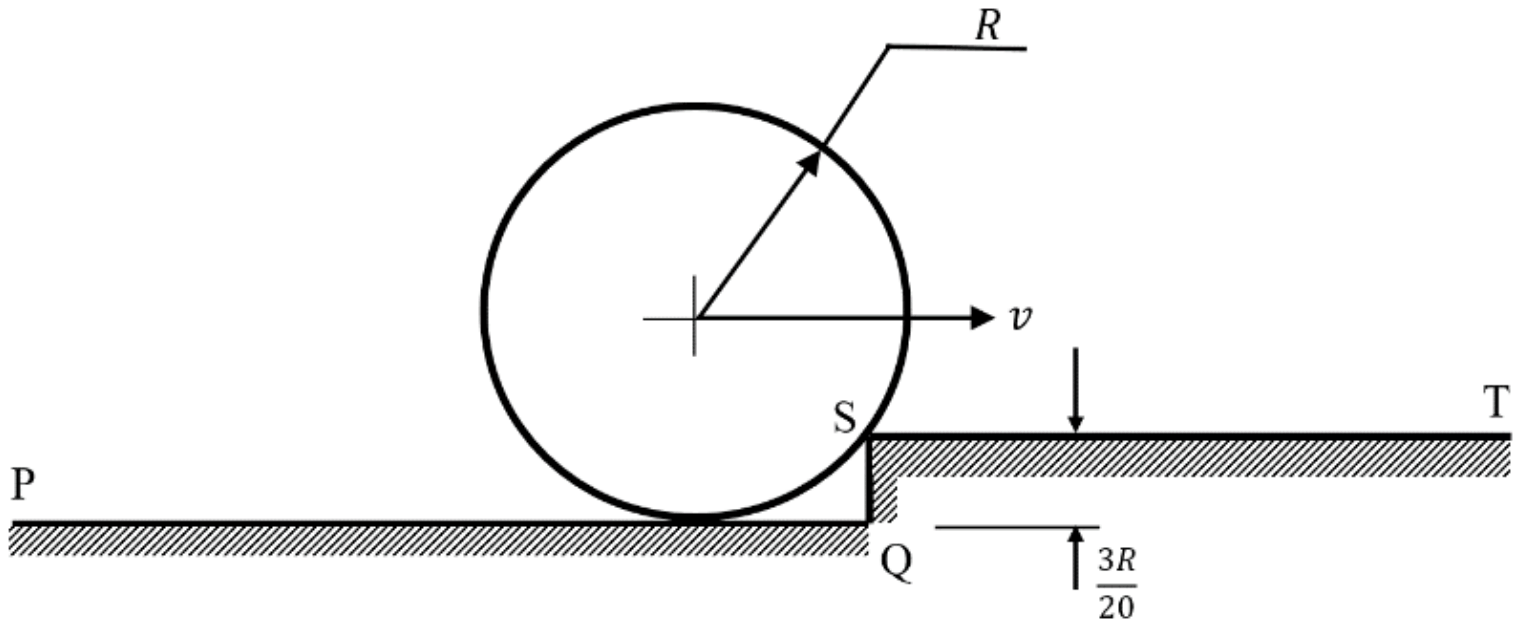
A solid uniform rigid disk of mass \(m\) and radius \(R\) rolls without slipping along a horizontal surface PQ. The speed of the center of the disk is \(v\). The disk then strikes a hurdle of height \(\frac{3R}{20}\) at point S. During the impact, there is no rebound or slip at S and no impulse from the surface PQ. The magnitude of the velocity of the center of the disk immediately after the impact is
Answer: D
The speed of the centre after impact is \(0.9v\).
The impulse at S passes through S, and there is no impulse from PQ, so angular momentum about S is conserved during the impact. Before impact the centre moves horizontally at \(v\), at height \(R - \frac{3R}{20} = \frac{17R}{20}\) above S, and the disk spins at \(\omega = v/R\):
\[ \begin{aligned} H_{S} &= mv\tfrac{17R}{20} + \tfrac{1}{2}mR^{2}\tfrac{v}{R} \\ &= \tfrac{27}{20}mvR \end{aligned} \]
After impact the disk pivots about S without slip or rebound, with moment of inertia about S of \(\frac{1}{2}mR^{2} + mR^{2} = \frac{3}{2}mR^{2}\):
\[ \begin{aligned} \tfrac{3}{2}mR^{2}\omega' &= \tfrac{27}{20}mvR \\ \omega' &= 0.9\tfrac{v}{R}, \quad v' = \omega' R = 0.9v \end{aligned} \]
Leaving out the spin term \(\frac{1}{2}mR^{2}\omega\) would give only about \(0.57v\); the disk's own rotation carries angular momentum into the impact, which is why the speed falls by only a tenth. 0.1v, 0.3v and 0.7v would all require angular momentum about S to be lost, which the stated conditions rule out.
Post your comment
Please log in or register to post a comment.
Examination Categories
- SSC Exams
- Banking Exams
- Teaching Exams
- Civil Services Exams
- Railways Exams
- Engineering Recruitment Exams
- Defence Exams
- State Government Exams
- Police Exams
- Insurance Exams
- Nursing Exams
- Other Government Exams
- NRA CET
- PG Entrance Exams
- Campus Placement
- MBA Entrance Exams
- CUET and UG Entrance
- Judiciary Exams
- Regulatory Body Exams
- Software Development