
Discussion
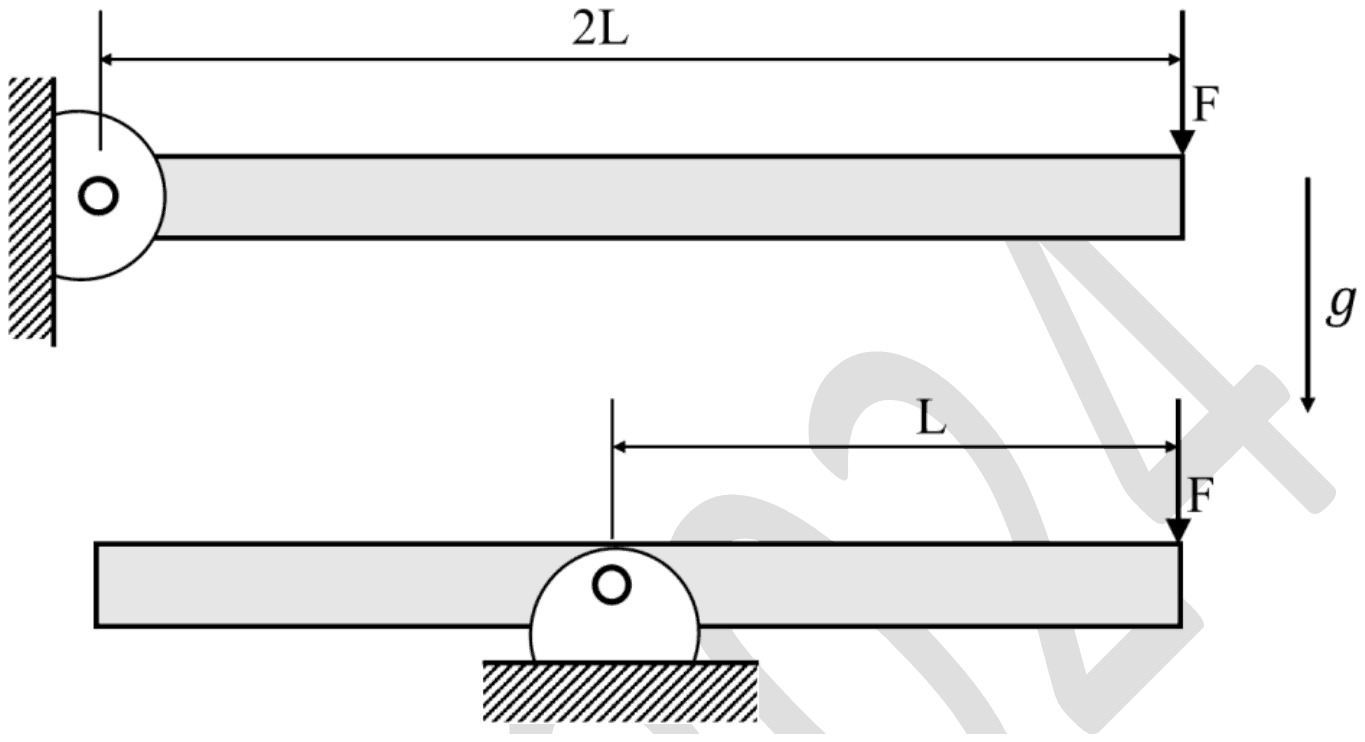
Two identical rigid slender bars of length 2L and mass \(m\) are acted upon by a transverse force F at one of the ends as shown in the figure. In the first case, the bar is pinned at the other end. In the second case, the bar is pinned at its mid-point. What should be the magnitude of the force F such that the resulting angular accelerations of the two bars are equal?
Answer: B
The force must be \(\frac{mg}{2}\).
Both bars are horizontal with F acting downward at the free end, so gravity adds to F in the end-pinned case but has no moment about the centre pin in the second case.
\[ \begin{aligned} \alpha_1 &= \frac{2FL + mgL}{\tfrac{4}{3}mL^{2}} = \frac{3(2F + mg)}{4mL} \\ \alpha_2 &= \frac{FL}{\tfrac{1}{3}mL^{2}} = \frac{3F}{mL} \end{aligned} \]
using \(I = m(2L)^{2}/3\) about an end and \(I = m(2L)^{2}/12\) about the centre. Setting \(\alpha_1 = \alpha_2\) gives \(2F + mg = 4F\), so \(F = mg/2\).
Ignoring gravity would make the two accelerations unequal for any F, and mg, mg/4 and mg/6 do not satisfy the balance above.
Post your comment
Please log in or register to post a comment.
Examination Categories
- SSC Exams
- Banking Exams
- Teaching Exams
- Civil Services Exams
- Railways Exams
- Engineering Recruitment Exams
- Defence Exams
- State Government Exams
- Police Exams
- Insurance Exams
- Nursing Exams
- Other Government Exams
- NRA CET
- PG Entrance Exams
- Campus Placement
- MBA Entrance Exams
- CUET and UG Entrance
- Judiciary Exams
- Regulatory Body Exams
- Software Development