
Discussion
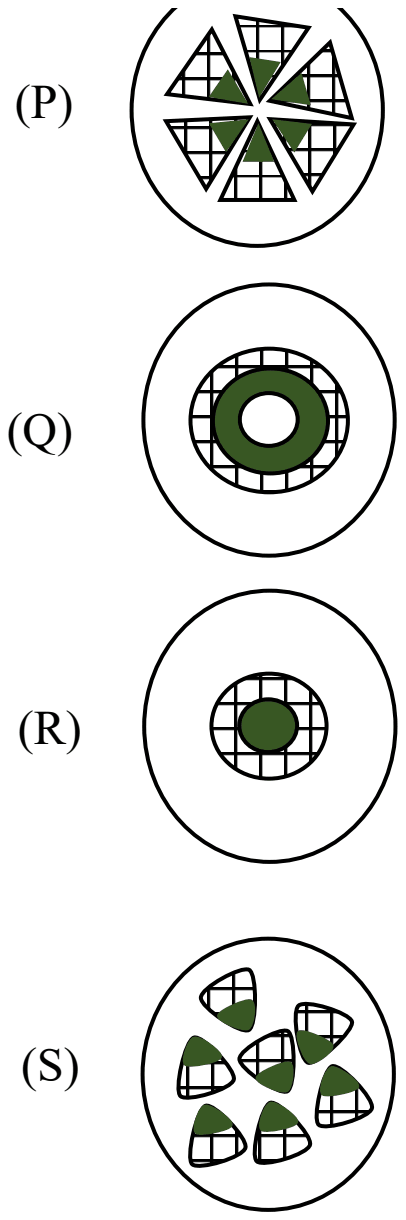
Central vascular cylinder or stele consists of the primary vascular system (xylem and phloem) and the associate fundamental tissue. Match the schematics of stele in Group I (xylem shown in green, and phloem shown as a square grid) with their respective types in Group II.
Group I:
Group II: (1) Protostele; (2) Eustele; (3) Atactostele; (4) Ectophloic siphonostele; (5) Amphiphloic siphonostele
Answer: A
The match is P-2; Q-4; R-1; S-3.
- P, a ring of separate collateral bundles with phloem outside the xylem around a central pith, is a eustele, typical of dicot and gymnosperm stems.
- Q, a continuous cylinder of xylem around a pith with phloem only on the outside, is an ectophloic siphonostele.
- R, a solid central core of xylem surrounded by phloem with no pith, is a protostele, the simplest type.
- S, with many bundles scattered through the ground tissue, is an atactostele, characteristic of monocot stems.
An amphiphloic siphonostele would show phloem on both sides of the xylem ring, which none of the drawings has, so options using item 5 are wrong.
No comment is present. Be the first to comment.
Loading…
Post your comment
Please log in or register to post a comment.
Examination Categories
- SSC Exams
- Banking Exams
- Teaching Exams
- Civil Services Exams
- Railways Exams
- Engineering Recruitment Exams
- Defence Exams
- State Government Exams
- Police Exams
- Insurance Exams
- Nursing Exams
- Other Government Exams
- NRA CET
- PG Entrance Exams
- Campus Placement
- MBA Entrance Exams
- CUET and UG Entrance
- Judiciary Exams
- Regulatory Body Exams
- Software Development