
Discussion
Consider two infinitely long thin concentric tubes of circular cross section as shown in the figure. If D1 and D2 are the diameters of the inner and outer tubes respectively, then the view factor F22 is given by
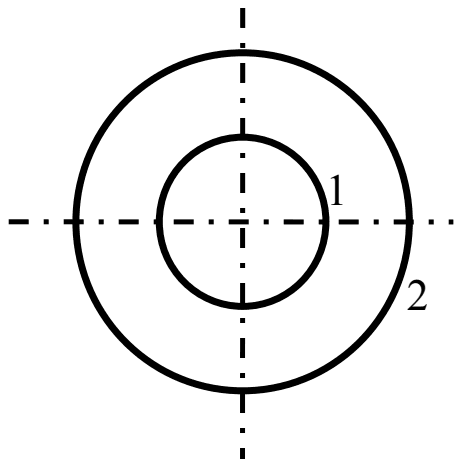
Answer: D
The view factor is \(F_{22} = 1-\frac{D_{1}}{D_{2}}\).
The inner tube is convex, so it cannot see itself, \(F_{11}=0\), and everything it emits reaches the outer tube, \(F_{12}=1\). Reciprocity, per unit length, gives:
\[ \begin{aligned} A_{1}F_{12} &= A_{2}F_{21} \\ F_{21} &= \frac{\pi D_{1}}{\pi D_{2}} = \frac{D_{1}}{D_{2}} \end{aligned} \]
The summation rule for surface 2 then gives \(F_{22} = 1 - F_{21} = 1 - D_{1}/D_{2}\).
\(D_{1}/D_{2}\) is F21, not F22. Zero would be true only for a convex surface, but the inside of the outer tube is concave and sees part of itself. \(D_{2}/D_{1}-1\) is greater than 1 for a large outer tube, which no view factor can be.
Post your comment
Please log in or register to post a comment.
Examination Categories
- SSC Exams
- Banking Exams
- Teaching Exams
- Civil Services Exams
- Railways Exams
- Engineering Recruitment Exams
- Defence Exams
- State Government Exams
- Police Exams
- Insurance Exams
- Nursing Exams
- Other Government Exams
- NRA CET
- PG Entrance Exams
- Campus Placement
- MBA Entrance Exams
- CUET and UG Entrance
- Judiciary Exams
- Regulatory Body Exams
- Software Development