
Discussion
Consider the E1 reaction of tert-amyl halides from the energy profile given below.
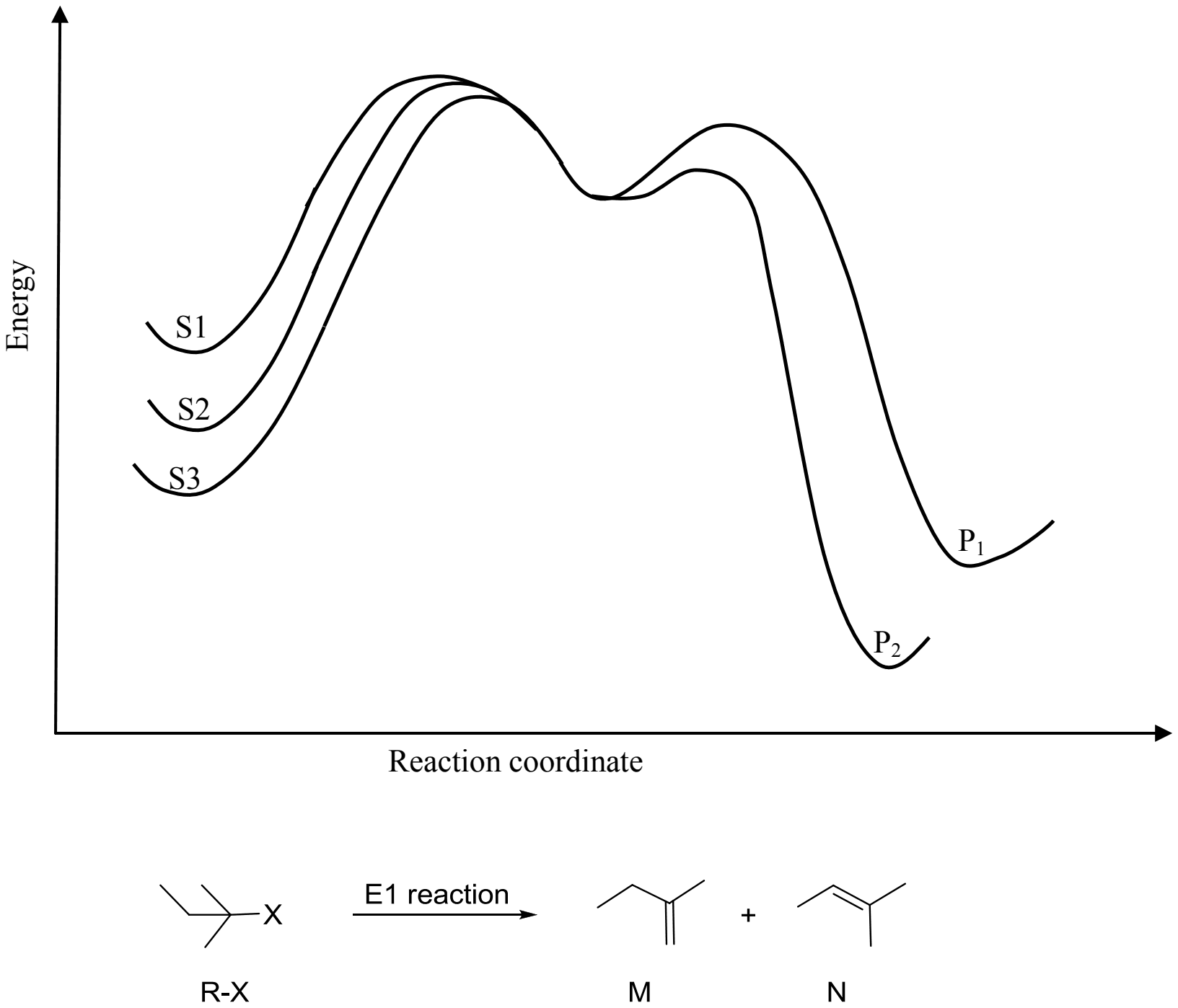
In the above reaction, X = Cl, Br or I. Based on the graph, identify the alkyl halides (R-X) as S1, S2 and S3
Answer: B
S1 = R-I, S2 = R-Br and S3 = R-Cl.
All three halides ionise to the same tert-amyl cation, so the curves meet at the intermediate. They differ in the energy of the starting halide relative to that cation. The C-X bond is weakest for iodide and strongest for chloride, so R-I lies highest (smallest barrier to ionisation, fastest) and R-Cl lowest (largest barrier, slowest), with R-Br between them.
That matches the plot: S1 starts highest and climbs least, S3 starts lowest and climbs most. The orders that put R-Cl at the top reverse the bond-strength trend, and the mixed orders do not follow it at all.
Post your comment
Please log in or register to post a comment.
Examination Categories
- SSC Exams
- Banking Exams
- Teaching Exams
- Civil Services Exams
- Railways Exams
- Engineering Recruitment Exams
- Defence Exams
- State Government Exams
- Police Exams
- Insurance Exams
- Nursing Exams
- Other Government Exams
- NRA CET
- PG Entrance Exams
- Campus Placement
- MBA Entrance Exams
- CUET and UG Entrance
- Judiciary Exams
- Regulatory Body Exams
- Software Development