
Discussion
Consider the E1 reaction of tert-amyl halides from the energy profile given below.
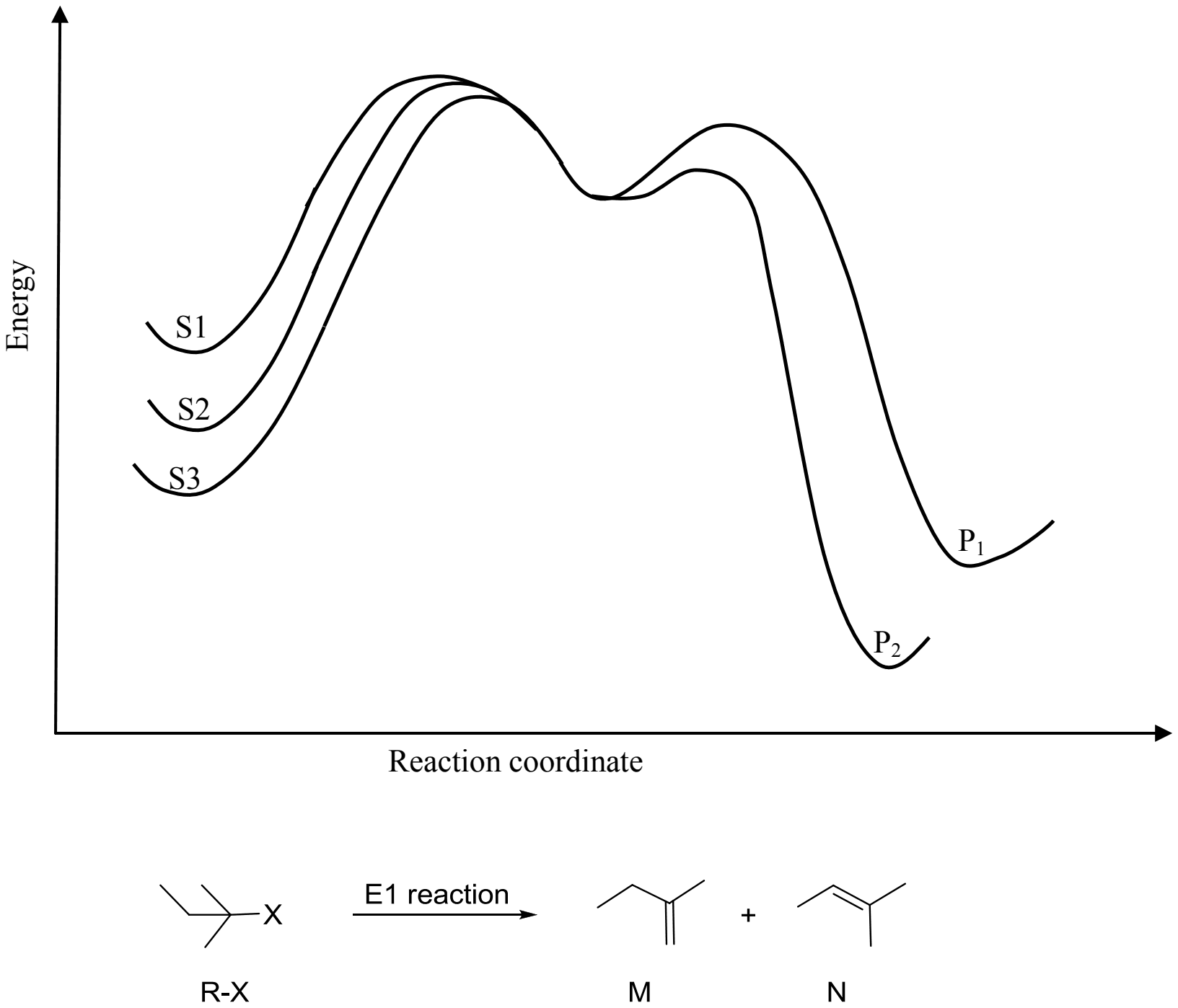
Identify product P1 and its yield relative to P2
Answer: D
P1 is M and is the minor product.
The common carbocation loses a proton in two ways: from the CH3 group to give M, 2-methylbut-1-ene (a disubstituted, terminal alkene), or from the CH2 group to give N, 2-methylbut-2-ene (a trisubstituted alkene). The more substituted alkene N is more stable (Zaitsev's rule), so it is the lower-energy product, P2, and the less stable M is P1.
The plot also shows a higher barrier from the cation to P1 than to P2. P1 is therefore formed more slowly and is the less stable product: by either measure it is the minor one.
Calling P1 N reverses the stabilities, and calling P1 the major product ignores both its higher barrier and its higher energy.
Post your comment
Please log in or register to post a comment.
Examination Categories
- SSC Exams
- Banking Exams
- Teaching Exams
- Civil Services Exams
- Railways Exams
- Engineering Recruitment Exams
- Defence Exams
- State Government Exams
- Police Exams
- Insurance Exams
- Nursing Exams
- Other Government Exams
- NRA CET
- PG Entrance Exams
- Campus Placement
- MBA Entrance Exams
- CUET and UG Entrance
- Judiciary Exams
- Regulatory Body Exams
- Software Development