
Discussion
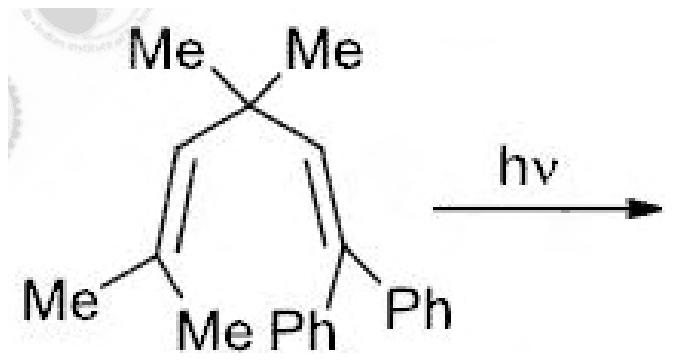
The product formed in the following photochemical reaction is
- A.
![Bicyclo[2.1.0]pentane with two phenyl groups on the cyclopropane carbon and four methyl groups on the two cyclobutane carbons](/uploads/question-images/gate-cy-2017/q47-a.png)
- B.
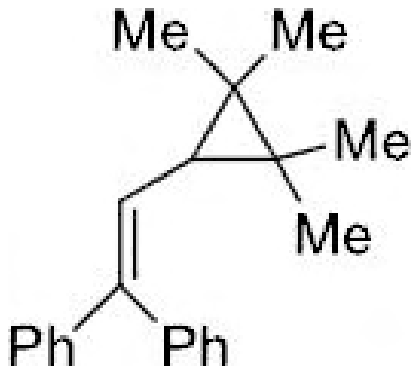
- C.
![Bicyclo[2.1.0]pentane with two methyl groups on the cyclopropane carbon, and one methyl plus one phenyl on each side carbon of the cyclobutane](/uploads/question-images/gate-cy-2017/q47-c.png)
- D.
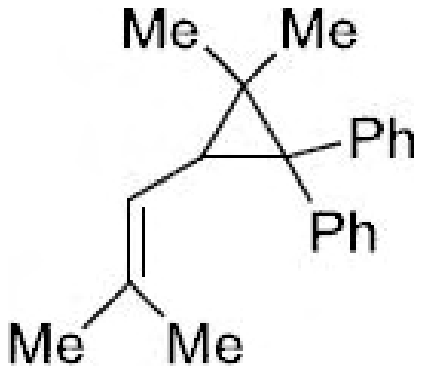
Answer: D
The product is (D), a vinylcyclopropane carrying the two phenyl groups on the ring and an isobutenyl side chain.
A 1,4-diene with an sp3 carbon between the two alkenes undergoes the photochemical di-π-methane rearrangement to a vinylcyclopropane. The excited diene first bonds C2 to C4, giving a cyclopropyl-dicarbinyl diradical with odd electrons on the two terminal carbons. One cyclopropane bond then opens, and the ring closes again to the vinylcyclopropane.
Which way it goes is set by radical stability. The odd electron on the diphenyl-substituted carbon is a stabilised benzhydryl radical and is kept; the cyclopropane opens so that the dimethyl-substituted end re-forms a double bond (Me2C=CH-). The final ring closure then joins the benzhydryl carbon to the central CMe2 carbon, so the cyclopropane contains CMe2 and CPh2, as in (D).
(B) is the product of the opposite opening, which would sacrifice the benzhydryl radical. (A) and (C) are bicyclo[2.1.0]pentanes, the products of an intramolecular [2+2] cycloaddition, not of the di-π-methane rearrangement.
Post your comment
Please log in or register to post a comment.
Examination Categories
- SSC Exams
- Banking Exams
- Teaching Exams
- Civil Services Exams
- Railways Exams
- Engineering Recruitment Exams
- Defence Exams
- State Government Exams
- Police Exams
- Insurance Exams
- Nursing Exams
- Other Government Exams
- NRA CET
- PG Entrance Exams
- Campus Placement
- MBA Entrance Exams
- CUET and UG Entrance
- Judiciary Exams
- Regulatory Body Exams
- Software Development