
Discussion
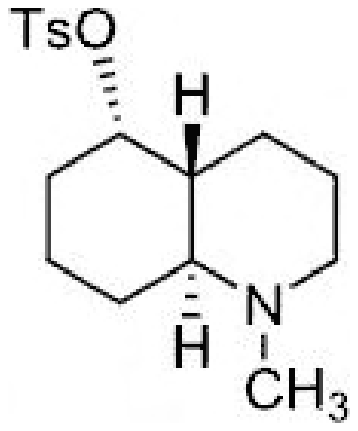
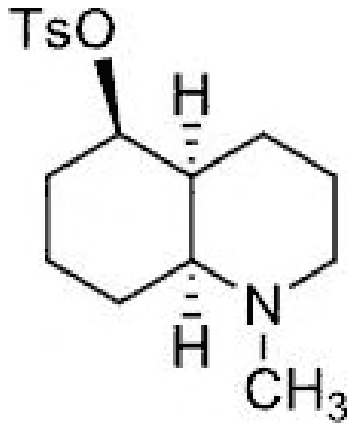
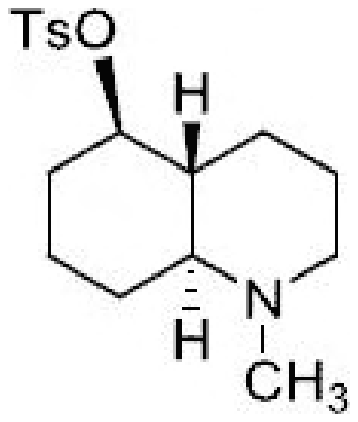
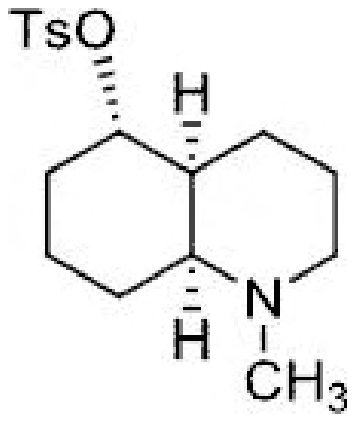
Among the following decahydroquinoline toluenesulfonates (Ts), the one that yields 9-methylamino-E-non-5-enal as a major product upon aqueous solvolysis is
- A.
- B.
- C.
- D.
Answer: C
The tosylate that fragments to 9-methylamino-E-non-5-enal is (C).
The product comes from a Grob fragmentation. The nitrogen lone pair pushes, the ring-fusion C-C bond (C4a-C8a) breaks, and the tosylate leaves, giving an iminium ion and a new C=C bond in what was the carbocyclic ring. Hydrolysis of the iminium ion in water releases the aldehyde and the methylamino group. The fragmentation is concerted only when the breaking C-C bond is anti-periplanar to the C-OTs bond, which also fixes the alkene as E.
In (C) the ring fusion is trans (one ring-fusion H up, the other down), and the tosylate is on the same side as the adjacent ring-fusion hydrogen, which in a trans-decalin-type ring makes it equatorial. An equatorial leaving group is anti-periplanar to the ring bond C4a-C8a, so it fragments cleanly.
In (A) the tosylate is axial, anti-periplanar to hydrogens rather than to the ring bond, so it undergoes elimination or substitution instead. (B) and (D) are cis-fused, without the rigid alignment that the trans isomer provides.
Post your comment
Please log in or register to post a comment.
Examination Categories
- SSC Exams
- Banking Exams
- Teaching Exams
- Civil Services Exams
- Railways Exams
- Engineering Recruitment Exams
- Defence Exams
- State Government Exams
- Police Exams
- Insurance Exams
- Nursing Exams
- Other Government Exams
- NRA CET
- PG Entrance Exams
- Campus Placement
- MBA Entrance Exams
- CUET and UG Entrance
- Judiciary Exams
- Regulatory Body Exams
- Software Development