
Discussion
The temperature dependence of the electrical conductivity \((\sigma)\) of three intrinsic semiconductors A, B and C is shown in figure.
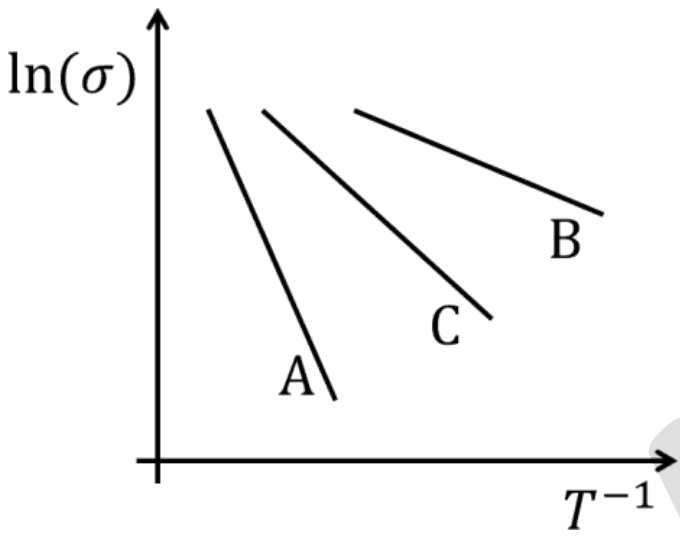
Let EA, EB and EC be the bandgaps of A, B and C, respectively. Which one of the following relations is correct?
Answer: D
The bandgaps satisfy EA > EC > EB.
For an intrinsic semiconductor the conductivity varies as
\[ \begin{aligned} \sigma &\propto e^{-E_{g}/2k_{B}T} \\ \ln\sigma &= \text{const} - \frac{E_{g}}{2k_{B}}\cdot\frac{1}{T} \end{aligned} \]
so on a plot of ln σ against 1/T the slope is -Eg/2kB. The steeper the line, the larger the bandgap. Line A is the steepest, C next and B the least steep.
The other orders mis-rank the slopes: putting C first, B first, or B above C would all require B or C to fall faster than the drawing shows.
Post your comment
Please log in or register to post a comment.
Examination Categories
- SSC Exams
- Banking Exams
- Teaching Exams
- Civil Services Exams
- Railways Exams
- Engineering Recruitment Exams
- Defence Exams
- State Government Exams
- Police Exams
- Insurance Exams
- Nursing Exams
- Other Government Exams
- NRA CET
- PG Entrance Exams
- Campus Placement
- MBA Entrance Exams
- CUET and UG Entrance
- Judiciary Exams
- Regulatory Body Exams
- Software Development