
Discussion
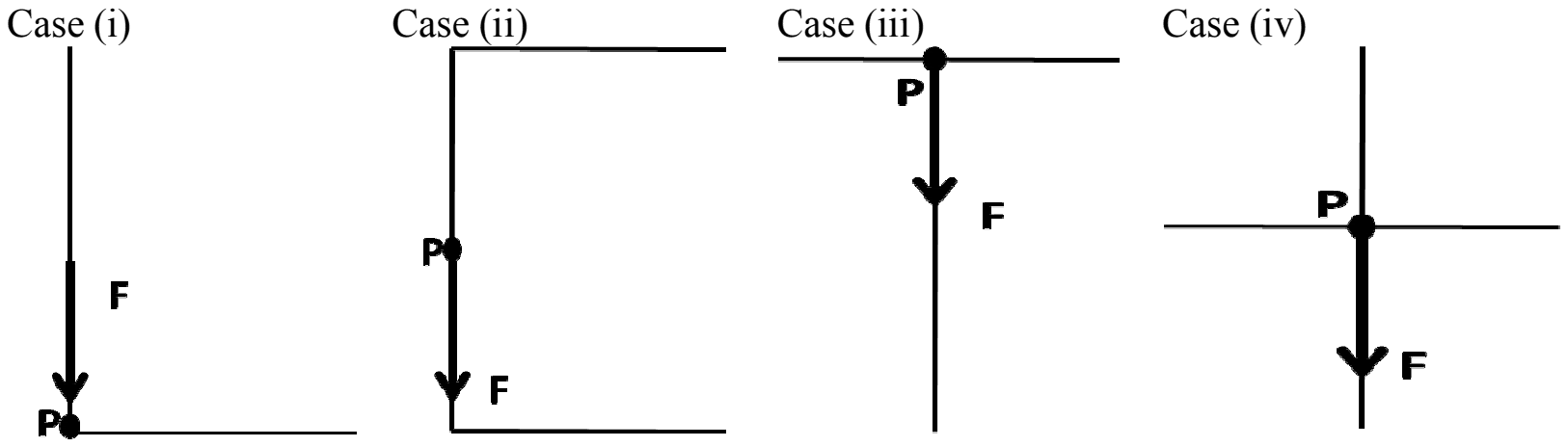
Consider four thin-walled beams of different open cross-sections, as shown in the cases (i-iv). A shear force of magnitude 'F' acts vertically downward at the location 'P' in all the beams. In which of the following case, does the shear force induce bending and twisting?
Answer: B
The force causes both bending and twisting in case (ii).
A shear force produces bending only if its line of action passes through the shear centre of the section; otherwise it also twists the beam. For sections made of thin walls meeting at one point, the shear centre is that meeting point.
- (i) Angle: the shear centre is at the corner where the legs meet, and P is at the corner, so there is no twist.
- (iii) T: the shear centre is at the web-flange junction, where P is, so there is no twist.
- (iv) Cross: the shear centre is at the centre, where P is, so there is no twist.
- (ii) Channel: the shear centre lies outside the web, on the side away from the flanges. The force acts along the web, offset from the shear centre, so it twists the channel as well as bending it.
No comment is present. Be the first to comment.
Loading…
Post your comment
Please log in or register to post a comment.
Examination Categories
- SSC Exams
- Banking Exams
- Teaching Exams
- Civil Services Exams
- Railways Exams
- Engineering Recruitment Exams
- Defence Exams
- State Government Exams
- Police Exams
- Insurance Exams
- Nursing Exams
- Other Government Exams
- NRA CET
- PG Entrance Exams
- Campus Placement
- MBA Entrance Exams
- CUET and UG Entrance
- Judiciary Exams
- Regulatory Body Exams
- Software Development