
Discussion
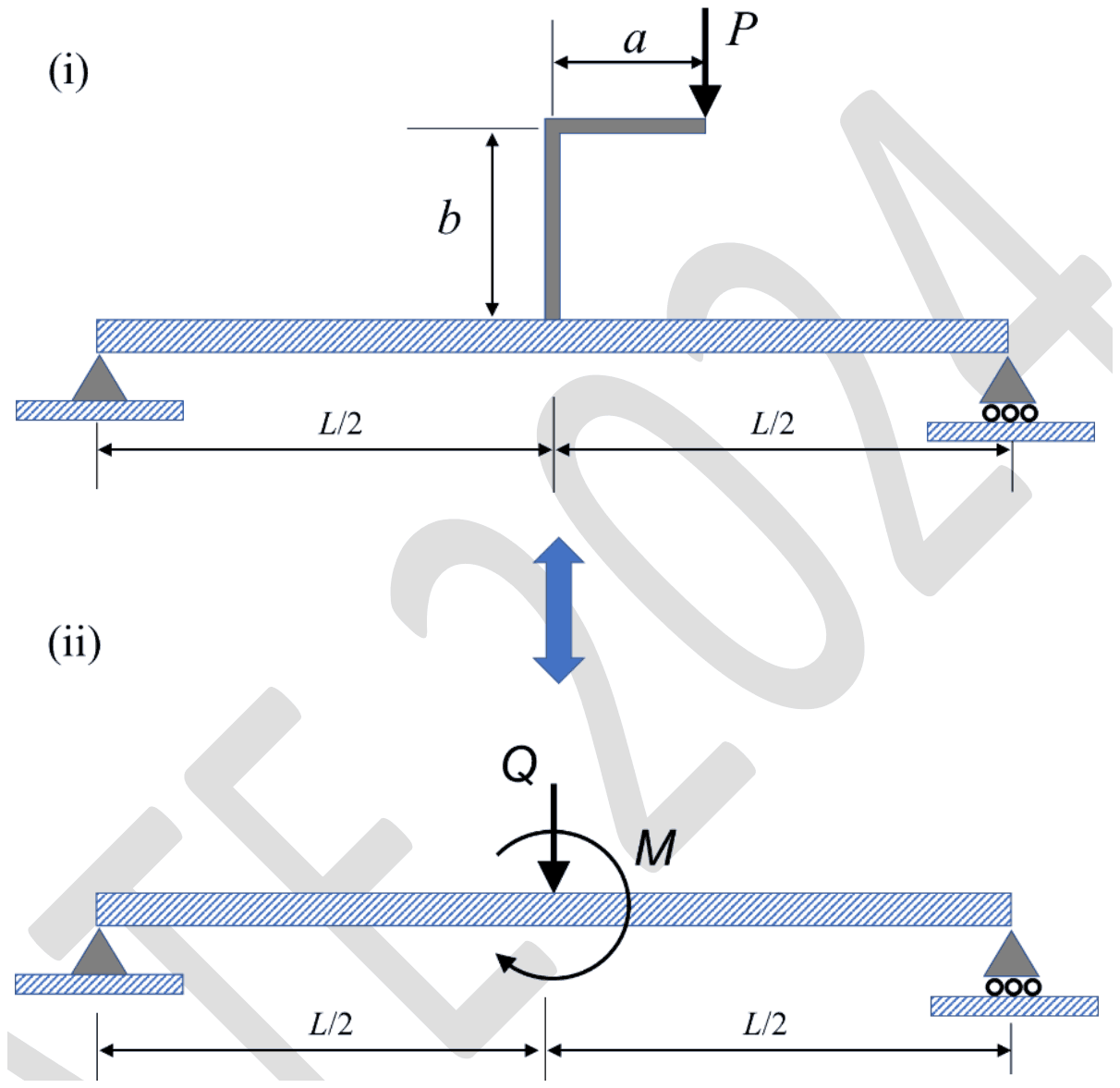
An L-shaped rigid member is fixed at the midpoint of a simply-supported beam, as shown in figure (i). The member is subjected to a vertically downward force \(P\) at its free end. In an equivalent system, the member along with the applied load is replaced with a force \(Q = P\) and a moment \(M\) (see figure (ii)). Which of the following statements is correct?
(Neglect the mass of the beam and of the rigid member)
Answer: A
The equivalent moment is \(M = Pa\).
Moving a force to a new point without changing its effect requires adding a couple equal to the force times the perpendicular distance between the old and new lines of action. P is vertical and acts at a horizontal distance a from the vertical leg, which is fixed at mid-span, so moving it to the beam gives Q = P plus
\[ M = P \times a \]
The height b does not count, because it is measured along the line of action of the vertical force and contributes no moment arm. That rules out Pb and P(a + b), and M = 0 would hold only if P acted directly above the attachment point.
Post your comment
Please log in or register to post a comment.
Examination Categories
- SSC Exams
- Banking Exams
- Teaching Exams
- Civil Services Exams
- Railways Exams
- Engineering Recruitment Exams
- Defence Exams
- State Government Exams
- Police Exams
- Insurance Exams
- Nursing Exams
- Other Government Exams
- NRA CET
- PG Entrance Exams
- Campus Placement
- MBA Entrance Exams
- CUET and UG Entrance
- Judiciary Exams
- Regulatory Body Exams
- Software Development