
Discussion
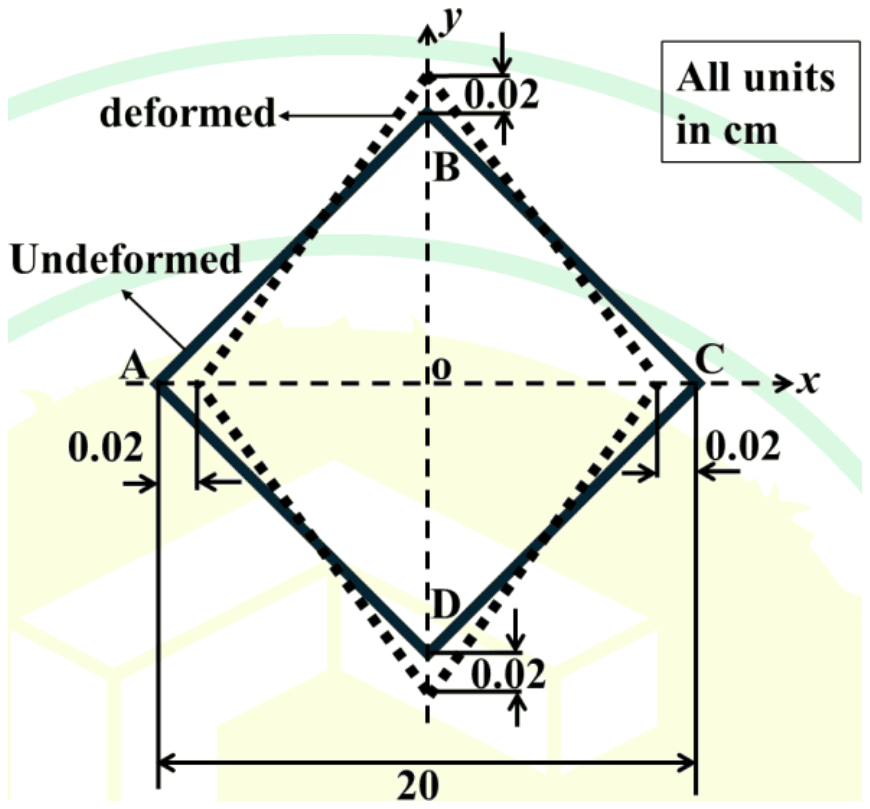
In the given figure, plate ABCD in its undeformed configuration (solid line) is a rhombus with all the internal angles being 90°. The lengths of the undeformed diagonals are 20 cm. ABCD deforms as shown by the dotted lines. Upon deformation, diagonal AC reduces to 19.96 cm and BD increases to 20.04 cm. In the given x-y coordinate system, the engineering shear strain \(\gamma_{xy}\) is equal to ____.
Answer: A
The engineering shear strain is 0.
The x and y axes run along the diagonals AC and BD. In the deformation, AC shortens and BD lengthens symmetrically about O, so points on the x axis stay on the x axis and points on the y axis stay on the y axis. The angle between the x and y directions remains 90°, so \(\gamma_{xy} = 0\), and the strains are purely normal:
\[ \begin{aligned} \varepsilon_{xx} &= \frac{19.96 - 20}{20} = -0.002 \\ \varepsilon_{yy} &= \frac{20.04 - 20}{20} = +0.002 \end{aligned} \]
The x and y axes are principal directions here. The sides of the square do change their angle: the shear strain measured along axes at 45° to x and y is \(\varepsilon_{yy} - \varepsilon_{xx} = 0.004\), the trap in options C and D. The value 0.002 is a normal strain, not a shear strain.
Post your comment
Please log in or register to post a comment.
Examination Categories
- SSC Exams
- Banking Exams
- Teaching Exams
- Civil Services Exams
- Railways Exams
- Engineering Recruitment Exams
- Defence Exams
- State Government Exams
- Police Exams
- Insurance Exams
- Nursing Exams
- Other Government Exams
- NRA CET
- PG Entrance Exams
- Campus Placement
- MBA Entrance Exams
- CUET and UG Entrance
- Judiciary Exams
- Regulatory Body Exams
- Software Development