
Discussion
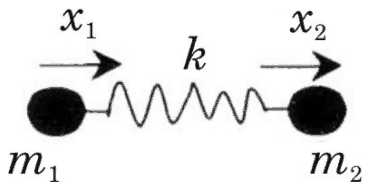
Two masses \(m_{1}\) and \(m_{2}\) are attached to the extreme ends of a massless spring of force constant k as shown in figure below. The system is at rest on a horizontal surface. The vibrational frequency w of the system is :
Answer: A
The frequency is \(\sqrt{\frac{k(m_{1}+m_{2})}{m_{1}m_{2}}}\).
The equations of motion are \(m_{1}\ddot{x}_{1} = k(x_{2} - x_{1})\) and \(m_{2}\ddot{x}_{2} = -k(x_{2} - x_{1})\). The centre of mass moves uniformly, and the extension \(x = x_{2} - x_{1}\) obeys
\[ \begin{aligned} \ddot{x} &= -k\left(\frac{1}{m_{1}} + \frac{1}{m_{2}}\right)x \\ &= -\frac{k}{\mu}x \\ \mu &= \frac{m_{1}m_{2}}{m_{1} + m_{2}} \end{aligned} \]
So the system oscillates like a single reduced mass \(\mu\) on the spring, with \(w = \sqrt{k/\mu}\), which is the keyed expression. Check: if \(m_{2} \to \infty\) (one end fixed) it reduces to \(\sqrt{k/m_{1}}\).
A difference \(m_{1} - m_{2}\) has no physical basis and would give zero or imaginary frequencies for equal masses, and the inverted forms have the dimensions of time, not frequency.
Post your comment
Please log in or register to post a comment.
Examination Categories
- SSC Exams
- Banking Exams
- Teaching Exams
- Civil Services Exams
- Railways Exams
- Engineering Recruitment Exams
- Defence Exams
- State Government Exams
- Police Exams
- Insurance Exams
- Nursing Exams
- Other Government Exams
- NRA CET
- PG Entrance Exams
- Campus Placement
- MBA Entrance Exams
- CUET and UG Entrance
- Judiciary Exams
- Regulatory Body Exams
- Software Development