
Discussion
Three different crystallographic planes of a unit cell of a metal are given below (solid circles represent atom). The crystal system of the unit cell is
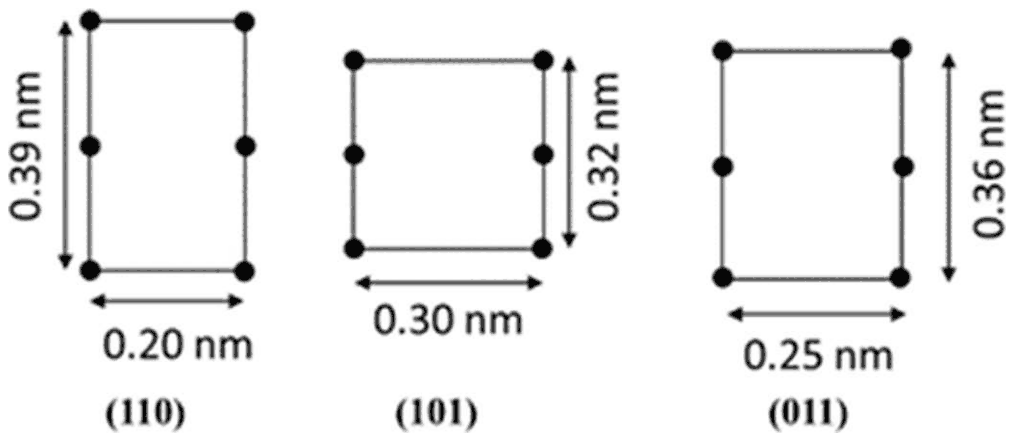
Answer: D
The unit cell is orthorhombic.
Each plane is a rectangle whose sides are one cell edge and one face diagonal. The (110) plane contains the edge c and the diagonal \(\sqrt{a^{2}+b^{2}}\); (101) contains b and \(\sqrt{a^{2}+c^{2}}\); (011) contains a and \(\sqrt{b^{2}+c^{2}}\). Taking the short sides as edges, \(c = 0.20\), \(b = 0.30\) and \(a = 0.25\) nm. The diagonals then check out:
\[ \begin{aligned} \sqrt{0.25^{2}+0.30^{2}} &= 0.39\ \text{nm} \\ \sqrt{0.25^{2}+0.20^{2}} &= 0.32\ \text{nm} \\ \sqrt{0.30^{2}+0.20^{2}} &= 0.36\ \text{nm} \end{aligned} \]
All three planes are rectangles, so the axes are mutually perpendicular, and the three edges are all different: \(a \ne b \ne c\) with all angles 90°, which defines the orthorhombic system. Tetragonal needs two equal edges, while monoclinic and triclinic need at least one non-right angle, which would make some of these sections parallelograms.
Post your comment
Please log in or register to post a comment.
Examination Categories
- SSC Exams
- Banking Exams
- Teaching Exams
- Civil Services Exams
- Railways Exams
- Engineering Recruitment Exams
- Defence Exams
- State Government Exams
- Police Exams
- Insurance Exams
- Nursing Exams
- Other Government Exams
- NRA CET
- PG Entrance Exams
- Campus Placement
- MBA Entrance Exams
- CUET and UG Entrance
- Judiciary Exams
- Regulatory Body Exams
- Software Development