
Discussion
Consider the phase diagram given below.
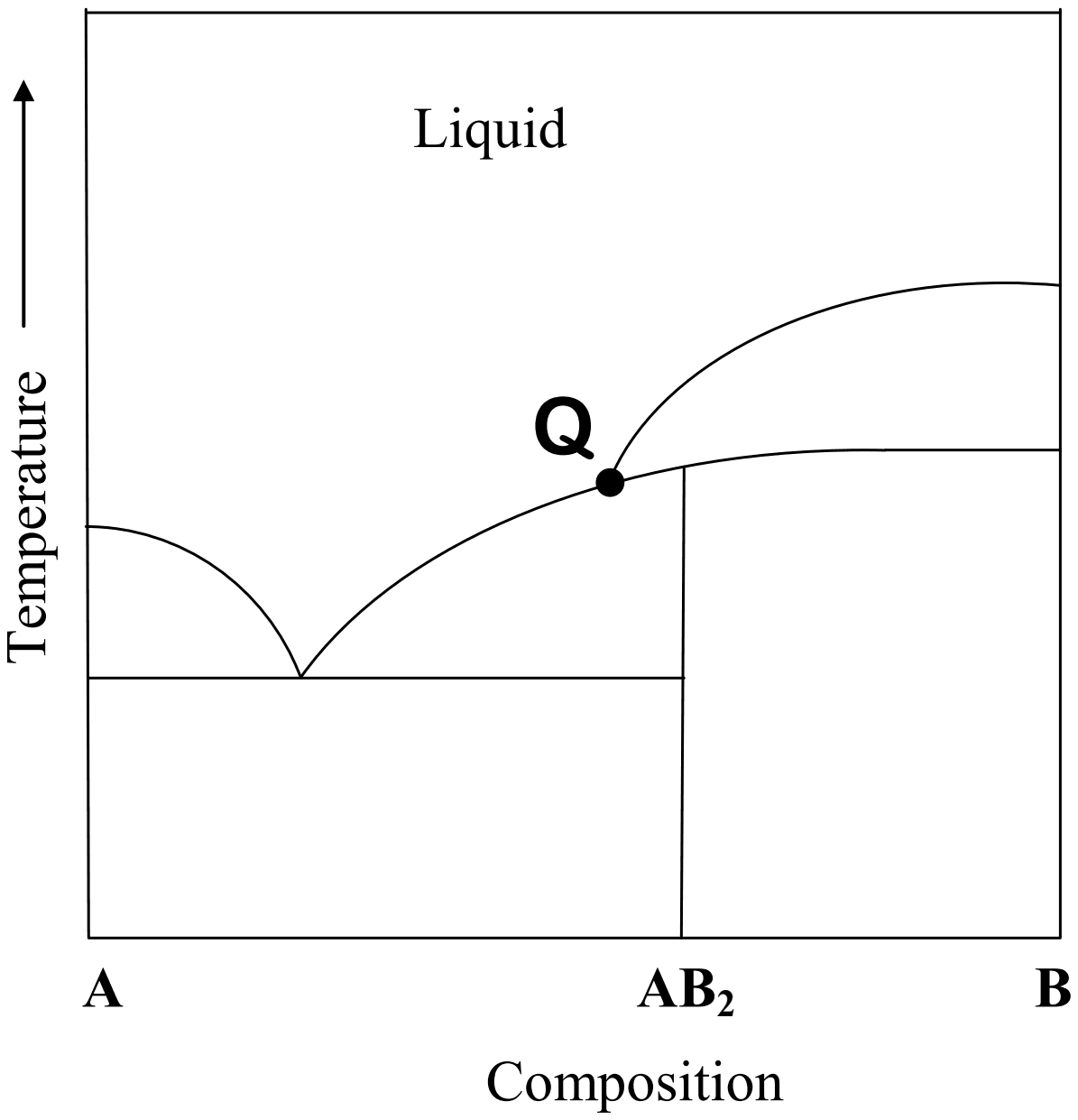
At the intersection point Q the phases that are in equilibrium are
Answer: C
At Q, solid B, solid AB2 and liquid are in equilibrium.
The vertical line for AB2 does not reach the liquid region: it stops at a horizontal line, so AB2 melts incongruently. At that temperature AB2 decomposes into solid B and a liquid of composition Q. Q is the peritectic point, where the liquidus coming down from the B side meets the horizontal peritectic line.
On the peritectic line three phases coexist: solid B, solid AB2 and liquid of composition Q. With three phases in a two-component system at fixed pressure, there are no degrees of freedom left, which is why the line is horizontal.
Solid A is not involved at Q: A appears only at the eutectic on the left. A three-solid equilibrium, or a four-phase one, is impossible at an invariant point of a binary system.
Post your comment
Please log in or register to post a comment.
Examination Categories
- SSC Exams
- Banking Exams
- Teaching Exams
- Civil Services Exams
- Railways Exams
- Engineering Recruitment Exams
- Defence Exams
- State Government Exams
- Police Exams
- Insurance Exams
- Nursing Exams
- Other Government Exams
- NRA CET
- PG Entrance Exams
- Campus Placement
- MBA Entrance Exams
- CUET and UG Entrance
- Judiciary Exams
- Regulatory Body Exams
- Software Development