
Discussion
An observer \(\bar{O}(\bar{t}, \bar{x})\) moves with a constant velocity in the positive \(x\)-direction relative to an observer \(O(t, x)\) at rest. In the frame of reference of \(\bar{O}(\bar{t}, \bar{x})\), a light-ray emitted at a point P at some time reaches the \(\bar{x}\)-axis at the point Q. Then, on reflection it arrives at point R, as shown in the figure.
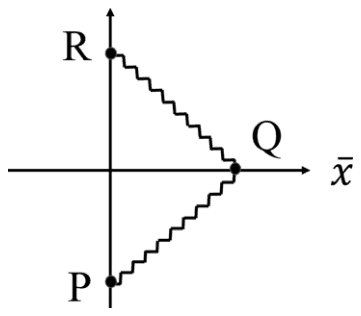
Which of the following options represents these events as observed by \(O(t, x)\)?
- A.
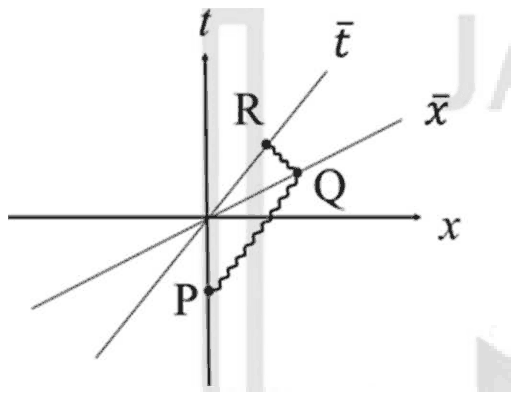
- B.
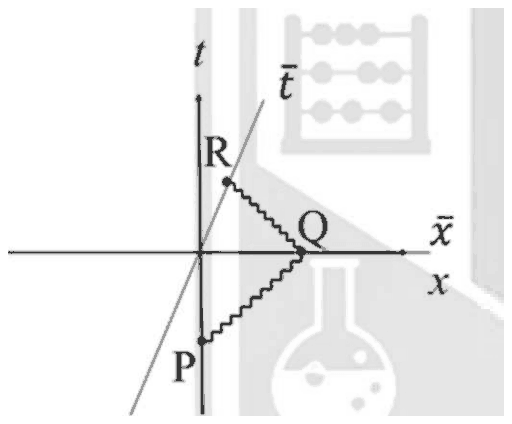
- C.

- D.
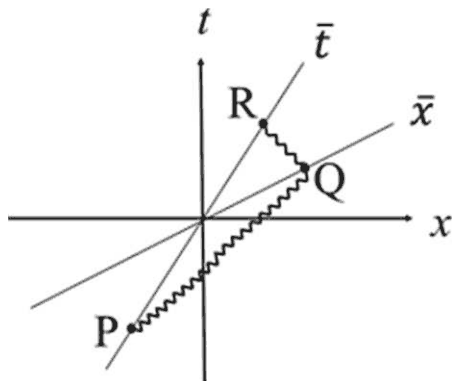
Answer: D
The correct diagram is (D).
In the frame of \(\bar{O}\), P and R lie on the \(\bar{t}\) axis (\(\bar{x} = 0\)), before and after the reflection, and Q lies on the \(\bar{x}\) axis (\(\bar{t} = 0\)) at positive \(\bar{x}\). These facts hold in every frame, because they describe which events share a position or a time for \(\bar{O}\).
Since \(\bar{O}\) moves along \(+x\), its worldline, the \(\bar{t}\) axis, tilts towards \(+x\) in the diagram of \(O\), and its \(\bar{x}\) axis tilts upwards by the same angle, as a mirror image about the light line. So P and R must sit on the tilted \(\bar{t}\) line and Q on the tilted \(\bar{x}\) line, with Q on the right.
(A) puts P on the vertical \(t\) axis, not on the \(\bar{t}\) axis. (B) draws the \(\bar{x}\) axis on top of the \(x\) axis, which is the Galilean picture and ignores the relativity of simultaneity. (C) places Q on the negative side, which would need \(\bar{O}\) to move the other way. Only (D) has P, R on \(\bar{t}\), Q on \(\bar{x}\) and Q to the right.
Post your comment
Please log in or register to post a comment.
Examination Categories
- SSC Exams
- Banking Exams
- Teaching Exams
- Civil Services Exams
- Railways Exams
- Engineering Recruitment Exams
- Defence Exams
- State Government Exams
- Police Exams
- Insurance Exams
- Nursing Exams
- Other Government Exams
- NRA CET
- PG Entrance Exams
- Campus Placement
- MBA Entrance Exams
- CUET and UG Entrance
- Judiciary Exams
- Regulatory Body Exams
- Software Development