
Discussion
The compound which gives a fragment at \(m/z\) = 124[M+H]+ is
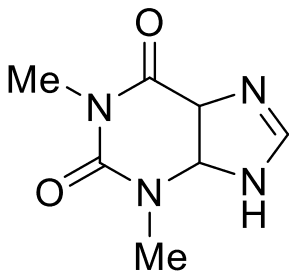
- A.
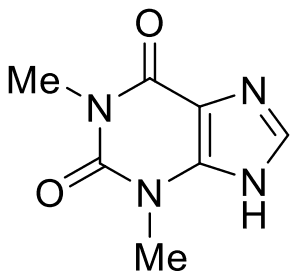
- B.
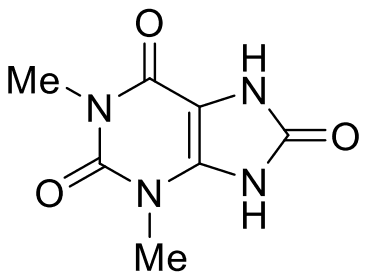
- C.
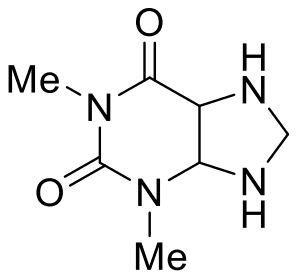
- D.
Answer: B
The compound is (B), theophylline (1,3-dimethylxanthine).
Theophylline is C7H8N4O2, mass 180, so its protonated molecule [M+H]+ appears at m/z 181. The characteristic fragmentation of the 1,3-dimethylxanthine ring is loss of methyl isocyanate (CH3NCO, 57) from the pyrimidinedione ring, which gives the ion at
\[ 181 - 57 = 124 \]
The same loss from the other structures gives different masses: (A), with two extra hydrogens at the ring fusion (C7H10N4O2, MH+ 183), gives 126; the uric acid (C), C7H8N4O3 (MH+ 197), gives 140; and the fully saturated (D), C7H12N4O2 (MH+ 185), gives 128.
No comment is present. Be the first to comment.
Loading…
Post your comment
Please log in or register to post a comment.
Examination Categories
- SSC Exams
- Banking Exams
- Teaching Exams
- Civil Services Exams
- Railways Exams
- Engineering Recruitment Exams
- Defence Exams
- State Government Exams
- Police Exams
- Insurance Exams
- Nursing Exams
- Other Government Exams
- NRA CET
- PG Entrance Exams
- Campus Placement
- MBA Entrance Exams
- CUET and UG Entrance
- Judiciary Exams
- Regulatory Body Exams
- Software Development