
Discussion
A compound, C15H16O2, has the following spectral data;
1H NMR (ppm): 9.16 (s), 6.89 (d, J = 8 Hz), 6.64 (d, J = 8 Hz), 1.53 (s)
13C NMR (ppm): 154.7, 140.9, 127.1, 114.4, 40.7, 30.7
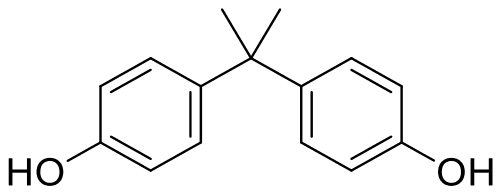
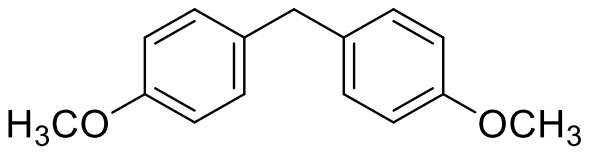
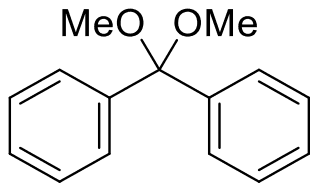
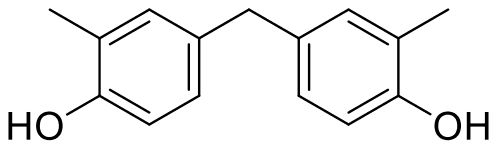
The structure of the compound is
- A.
- B.
- C.
- D.
Answer: A
The compound is (A), bisphenol A, 2,2-bis(4-hydroxyphenyl)propane.
- 1H: 9.16 (s) is the two phenolic OH protons (typical in DMSO); 6.89 and 6.64 (d, J = 8 Hz) are the two pairs of ortho-coupled ring protons of a para-disubstituted benzene, the 6.64 signal being ortho to OH; 1.53 (s) is the six protons of two equivalent methyl groups on a quaternary carbon.
- 13C: six signals for a symmetric molecule: 154.7 (C-OH), 140.9 (ring carbon bearing the CMe2), 127.1 and 114.4 (ring CH), 40.7 (quaternary CMe2) and 30.7 (CH3).
All four structures fit C15H16O2, so the spectra decide. (B) would show OCH3 and ArCH2Ar singlets near 3.7 to 3.8 ppm and no OH. (C) has monosubstituted phenyl rings, not two doublets, and methoxy singlets near 3 ppm. (D) would show three aromatic signals per ring, an aryl methyl near 2.1 ppm and a CH2 near 3.7 ppm, not a six-proton singlet at 1.53.
No comment is present. Be the first to comment.
Loading…
Post your comment
Please log in or register to post a comment.
Examination Categories
- SSC Exams
- Banking Exams
- Teaching Exams
- Civil Services Exams
- Railways Exams
- Engineering Recruitment Exams
- Defence Exams
- State Government Exams
- Police Exams
- Insurance Exams
- Nursing Exams
- Other Government Exams
- NRA CET
- PG Entrance Exams
- Campus Placement
- MBA Entrance Exams
- CUET and UG Entrance
- Judiciary Exams
- Regulatory Body Exams
- Software Development