
Discussion
Consider the following 1H-NMR (400 MHz, DMSO-d6) data of a compound:
δ in ppm: 3.85 (s, 6H), 6.73 (t, J = 2.2 Hz, 1H), 7.1 (d, J = 2.2 Hz, 2H), and 13.05 (brs, 1H).
The compound is
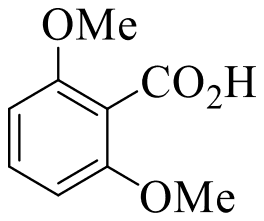
- A.
- B.
- C.
- D.
Answer: B
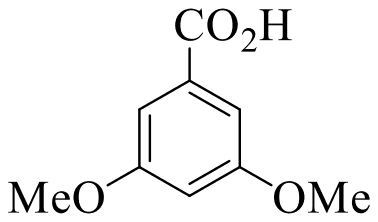
The compound is (B), 3,5-dimethoxybenzoic acid.
The data: a 6H singlet at 3.85 ppm (two equivalent OCH3 groups), a broad 1H singlet at 13.05 ppm (CO2H), and three aromatic protons as a 2H doublet and a 1H triplet with the small coupling of 2.2 Hz, typical of meta coupling.
In 3,5-dimethoxybenzoic acid, H2 and H6 are equivalent and each is meta to H4, giving the 2H doublet; H4 is meta to both and appears as a 1H triplet. No ortho coupling (about 8 Hz) appears, so no two ring protons are adjacent.
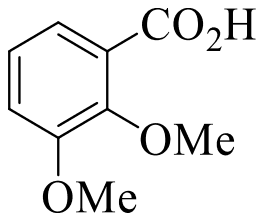
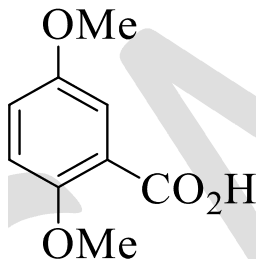
2,6-dimethoxybenzoic acid (A) has three adjacent protons and would show ortho couplings. The 2,3- and 2,5-isomers (C, D) have non-equivalent methoxy groups, giving two 3H singlets, as well as ortho couplings.
Post your comment
Please log in or register to post a comment.
Examination Categories
- SSC Exams
- Banking Exams
- Teaching Exams
- Civil Services Exams
- Railways Exams
- Engineering Recruitment Exams
- Defence Exams
- State Government Exams
- Police Exams
- Insurance Exams
- Nursing Exams
- Other Government Exams
- NRA CET
- PG Entrance Exams
- Campus Placement
- MBA Entrance Exams
- CUET and UG Entrance
- Judiciary Exams
- Regulatory Body Exams
- Software Development