
Discussion
The correct match for the protons labeled in compound X in Column M with the corresponding chemical shifts (δ, ppm) in Column N is
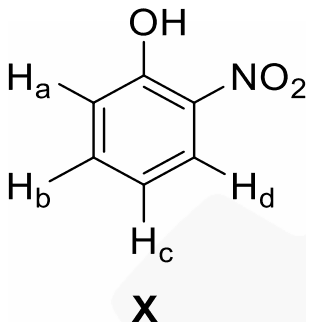
| Column M | Column N | ||
|---|---|---|---|
| P | Ha | I | 7.00 (ddd, J = 8.4, 7.3, 1.4 Hz, 1H) |
| Q | Hb | II | 7.17 (dd, J = 8.4, 1.4 Hz, 1H) |
| R | Hc | III | 7.59 (ddd, J = 8.4, 7.3, 1.4 Hz, 1H) |
| S | Hd | IV | 8.12 (dd, J = 8.4, 1.4 Hz, 1H) |
Answer: A
The correct match is P → II; Q → III; R → I; S → IV.
Compound X is 2-nitrophenol. Use the splitting first: a proton with two ortho neighbours appears as a ddd (two ortho couplings, 8.4 and 7.3 Hz, and one meta), while a proton with one ortho neighbour is a dd. Ha and Hd each have only one ortho neighbour, so they are the two dd signals; Hb and Hc are the ddd signals.
- Hd is ortho to the strongly withdrawing NO2, so it is the most deshielded dd: 8.12 (IV).
- Ha is ortho to the donating OH, the shielded dd: 7.17 (II).
- Hb is para to NO2, the deshielded ddd: 7.59 (III).
- Hc is para to OH, the shielded ddd: 7.00 (I).
Every other option breaks the splitting rule by giving a dd proton a ddd signal (P → I, or Q → IV), or swaps Hb and Hc, ignoring that the para nitro group deshields Hb.
No comment is present. Be the first to comment.
Loading…
Post your comment
Please log in or register to post a comment.
Examination Categories
- SSC Exams
- Banking Exams
- Teaching Exams
- Civil Services Exams
- Railways Exams
- Engineering Recruitment Exams
- Defence Exams
- State Government Exams
- Police Exams
- Insurance Exams
- Nursing Exams
- Other Government Exams
- NRA CET
- PG Entrance Exams
- Campus Placement
- MBA Entrance Exams
- CUET and UG Entrance
- Judiciary Exams
- Regulatory Body Exams
- Software Development