
Discussion
For a longitudinally statically stable aircraft, which one of the following represents the relationship between the coefficient of pitching moment about the center of gravity \(C_{m_{cg}}\) and absolute angle of attack \(\alpha_{a}\)?
(Note: nose-up moment is positive.)
- A.
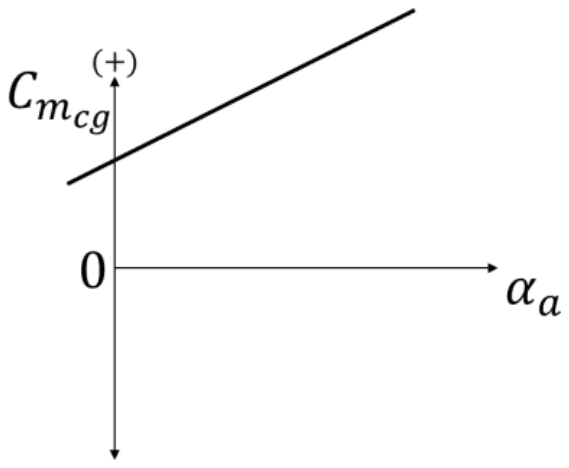
- B.
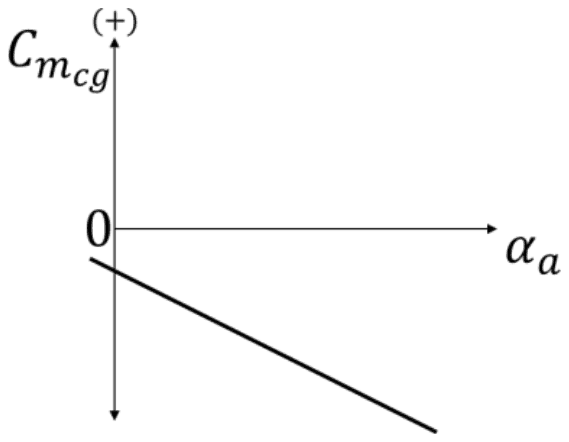
- C.
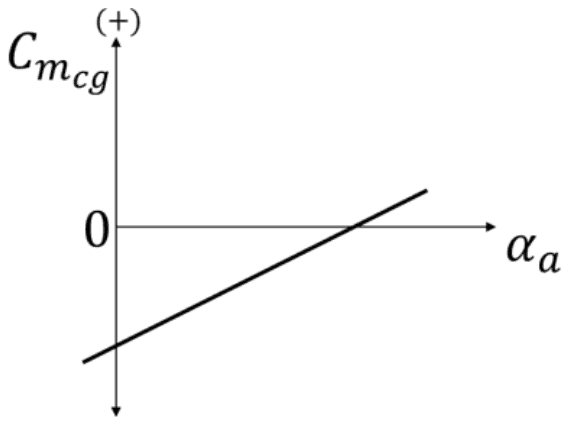
- D.
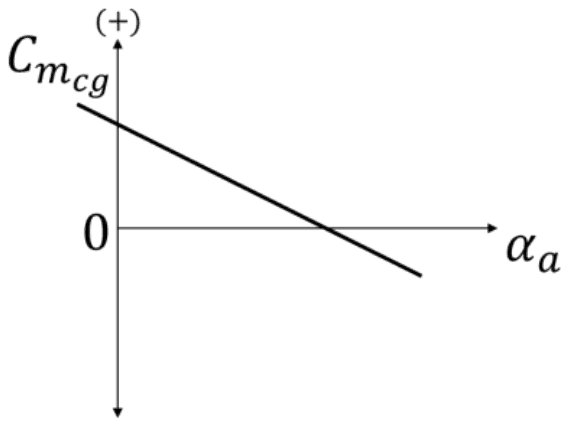
Answer: D
The stable relationship is graph (D): positive \(C_{m_{cg}}\) at zero lift and a negative slope.
Static longitudinal stability needs \(dC_{m_{cg}}/d\alpha_{a} \lt 0\): if a gust raises the angle of attack, the aircraft must develop a nose-down (negative) moment that returns it. Trim also has to be possible at a positive angle of attack, where the wing gives positive lift, so \(C_{m_{cg}}\) must pass through zero at some positive \(\alpha_{a}\). With a negative slope, that means the line starts from a positive value \(C_{m_{0}}\) at \(\alpha_{a} = 0\), which is graph (D).
Graphs (A) and (C) have a positive slope and are statically unstable. Graph (B) has the right negative slope but a negative \(C_{m_{0}}\), so it only reaches zero moment at a negative angle of attack, where lift is negative: the aircraft would be stable but could not be trimmed in normal flight.
Post your comment
Please log in or register to post a comment.
Examination Categories
- SSC Exams
- Banking Exams
- Teaching Exams
- Civil Services Exams
- Railways Exams
- Engineering Recruitment Exams
- Defence Exams
- State Government Exams
- Police Exams
- Insurance Exams
- Nursing Exams
- Other Government Exams
- NRA CET
- PG Entrance Exams
- Campus Placement
- MBA Entrance Exams
- CUET and UG Entrance
- Judiciary Exams
- Regulatory Body Exams
- Software Development