
Discussion
Select the correct option to match the Polymer to its most suitable Monomer(s) from the table given below:
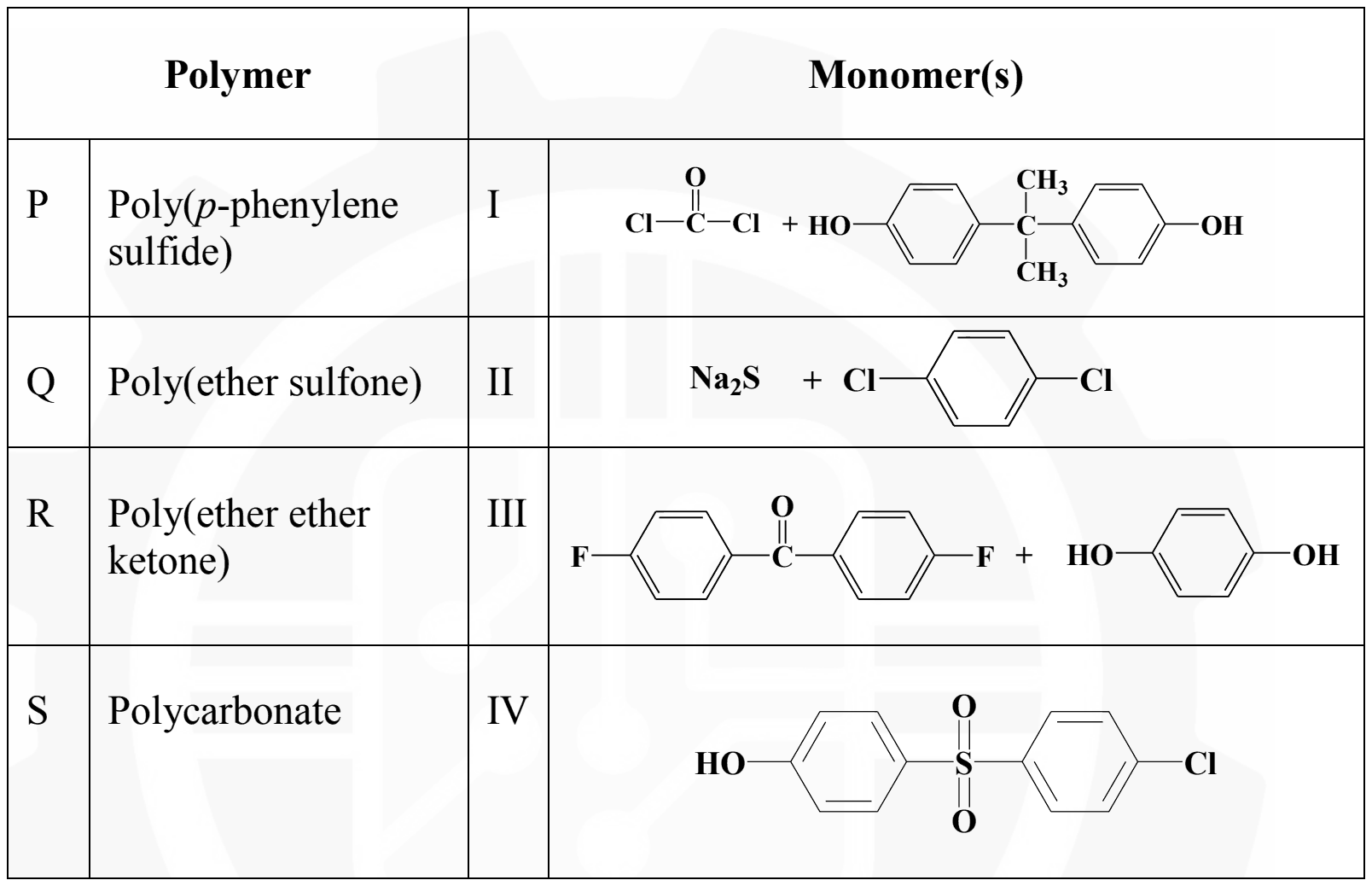
Answer: A
The correct matching is P-II ; Q-IV ; R-III ; S-I.
- Poly(p-phenylene sulfide) is made from sodium sulfide and p-dichlorobenzene, joining benzene rings through sulfur (II).
- Poly(ether sulfone) comes from the self-condensation of 4-chloro-4'-hydroxydiphenyl sulfone, which forms ether links between sulfone units (IV).
- PEEK is made from 4,4'-difluorobenzophenone and hydroquinone, giving two ether links and one ketone per repeat unit (III).
- Polycarbonate is made from phosgene and bisphenol A (I).
The other options assign the sulfone-containing monomer to PEEK or the phosgene route to a sulfide or sulfone polymer, which does not give the named backbone.
No comment is present. Be the first to comment.
Loading…
Post your comment
Please log in or register to post a comment.
Examination Categories
- SSC Exams
- Banking Exams
- Teaching Exams
- Civil Services Exams
- Railways Exams
- Engineering Recruitment Exams
- Defence Exams
- State Government Exams
- Police Exams
- Insurance Exams
- Nursing Exams
- Other Government Exams
- NRA CET
- PG Entrance Exams
- Campus Placement
- MBA Entrance Exams
- CUET and UG Entrance
- Judiciary Exams
- Regulatory Body Exams
- Software Development