
Discussion
Among the following, the chiral compound is
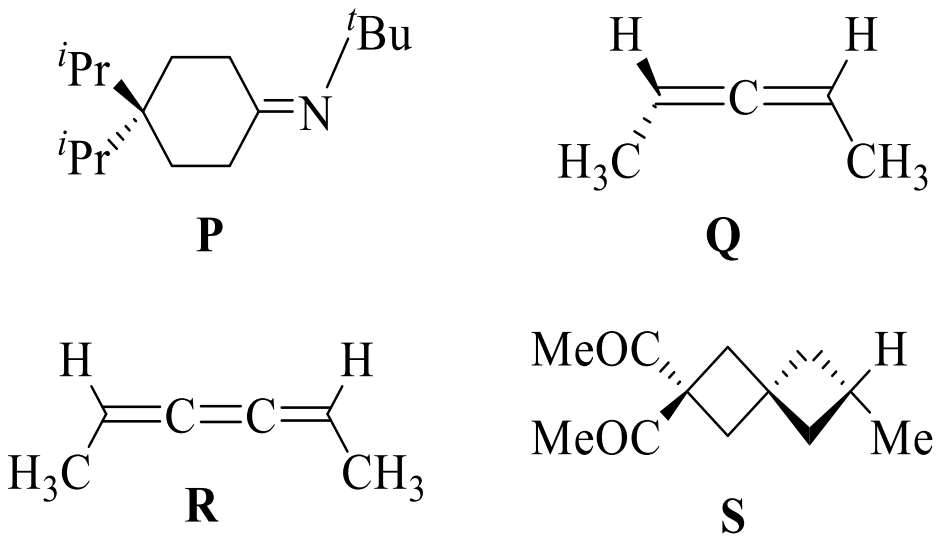
Answer: B
The chiral compound is Q.
Q is penta-2,3-diene, an allene with two different groups (H and CH3) on each terminal carbon. In an allene the two terminal planes are perpendicular, so the molecule has no mirror plane and is axially chiral.
R has three cumulated double bonds; with an odd number the terminal substituents lie in one plane, giving cis-trans isomers but not chirality. P would be axially chiral only if the two groups on C4 differed, but both are isopropyl. S is a spiro[3.3]heptane, which is axially chiral only when each terminal carbon carries two different groups; here one carbon has two identical acetyl groups. So P, R and S are achiral.
No comment is present. Be the first to comment.
Loading…
Post your comment
Please log in or register to post a comment.
Examination Categories
- SSC Exams
- Banking Exams
- Teaching Exams
- Civil Services Exams
- Railways Exams
- Engineering Recruitment Exams
- Defence Exams
- State Government Exams
- Police Exams
- Insurance Exams
- Nursing Exams
- Other Government Exams
- NRA CET
- PG Entrance Exams
- Campus Placement
- MBA Entrance Exams
- CUET and UG Entrance
- Judiciary Exams
- Regulatory Body Exams
- Software Development