
Discussion
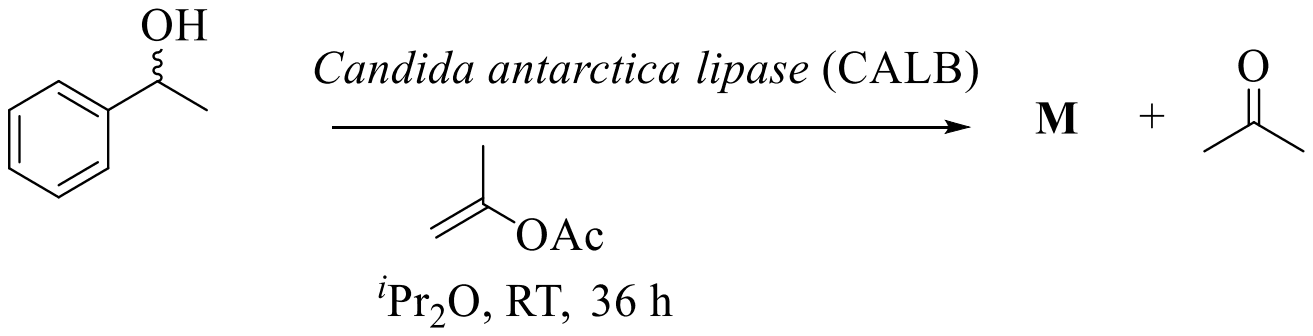
The product M in the following reaction is
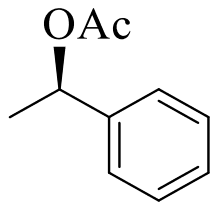
- A.
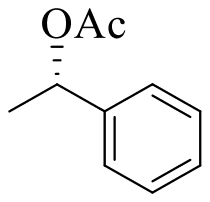
- B.
- C.

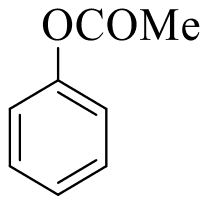
- D.
Answer: A
M is (A), (R)-1-phenylethyl acetate.
Candida antarctica lipase B carries out a kinetic resolution: it acetylates one enantiomer of racemic 1-phenylethanol much faster than the other. By Kazlauskas' rule for secondary alcohols, the lipase acylates the (R) enantiomer, in which the large (phenyl) and medium (methyl) groups fit its pockets, leaving the (S) alcohol behind. Isopropenyl acetate is the acyl donor; its enol by-product tautomerises to acetone, which makes the transfer irreversible.
In (A) the OAc is on a wedge with methyl to the left and phenyl to the right, which is the (R) configuration; (B) is the (S) acetate. Styrene (C) would need elimination, and phenyl acetate (D) has lost the CH(CH3) carbon, neither of which a lipase does.
Post your comment
Please log in or register to post a comment.
Examination Categories
- SSC Exams
- Banking Exams
- Teaching Exams
- Civil Services Exams
- Railways Exams
- Engineering Recruitment Exams
- Defence Exams
- State Government Exams
- Police Exams
- Insurance Exams
- Nursing Exams
- Other Government Exams
- NRA CET
- PG Entrance Exams
- Campus Placement
- MBA Entrance Exams
- CUET and UG Entrance
- Judiciary Exams
- Regulatory Body Exams
- Software Development