
Discussion
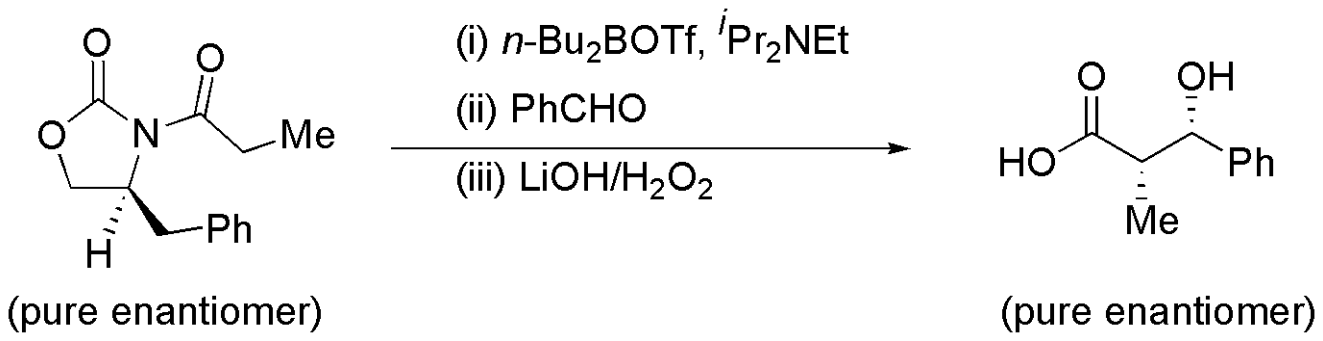
In the following asymmetric transformation, the key aldol reaction involves the attack of
Answer: D
The answer is Re face of enolate on to the Si face of aldehyde.
Bu2BOTf and Hunig's base give the Z-boron enolate of the Evans imide, which adds to benzaldehyde through a chair (Zimmerman-Traxler) transition state on the face left open by the benzyl group, giving the syn aldol. Reading the product as drawn, both new centres are S: (2S,3S)-3-hydroxy-2-methyl-3-phenylpropanoic acid.
At C3 the priorities are OH \(\gt\) Ph \(\gt\) C2 \(\gt\) H, so the incoming carbon ranks third; attack on the Si face of PhCHO then gives S. At C2 the priorities in the adduct are C(O)N \(\gt\) CH(O)Ph \(\gt\) CH3 \(\gt\) H, so the new bond ranks second; bond formation on the Re face of the enolate carbon then gives S. Each of the other three options would give at least one centre of the opposite configuration.
Post your comment
Please log in or register to post a comment.
Examination Categories
- SSC Exams
- Banking Exams
- Teaching Exams
- Civil Services Exams
- Railways Exams
- Engineering Recruitment Exams
- Defence Exams
- State Government Exams
- Police Exams
- Insurance Exams
- Nursing Exams
- Other Government Exams
- NRA CET
- PG Entrance Exams
- Campus Placement
- MBA Entrance Exams
- CUET and UG Entrance
- Judiciary Exams
- Regulatory Body Exams
- Software Development