
Discussion
The correct statement about the following quaternary ammonium ion is
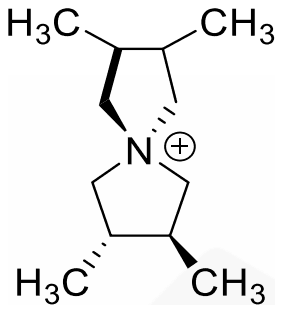
Answer: B
The correct statement is It has \(S_{4}\)-symmetry, hence achiral.
The ion is a spiro compound: the two pyrrolidine rings share the nitrogen and lie in perpendicular planes. Each ring carries a trans pair of methyl groups, and the two rings carry their pairs in mirror-image configurations. An \(S_{4}\) axis runs through the nitrogen, bisecting both rings: rotating by 90° carries one ring onto the position of the other, and reflecting through the plane perpendicular to the axis then restores the configuration, so the ion is reproduced.
A molecule with any improper axis \(S_{n}\) is superimposable on its mirror image, so the ion is achiral, even though it has neither a mirror plane nor a centre of symmetry. That is why this ion is the standard example of an achiral molecule that has no \(\sigma\) and no i.
It does contain a \(C_{2}\) axis (since \(S_{4}^{2} = C_{2}\)), but 'only \(C_{2}\), hence chiral' misses the \(S_{4}\). 'No symmetry' is wrong for the same reason, and there is no centre of symmetry.
Post your comment
Please log in or register to post a comment.
Examination Categories
- SSC Exams
- Banking Exams
- Teaching Exams
- Civil Services Exams
- Railways Exams
- Engineering Recruitment Exams
- Defence Exams
- State Government Exams
- Police Exams
- Insurance Exams
- Nursing Exams
- Other Government Exams
- NRA CET
- PG Entrance Exams
- Campus Placement
- MBA Entrance Exams
- CUET and UG Entrance
- Judiciary Exams
- Regulatory Body Exams
- Software Development