
Discussion
The major product formed in the following reaction is
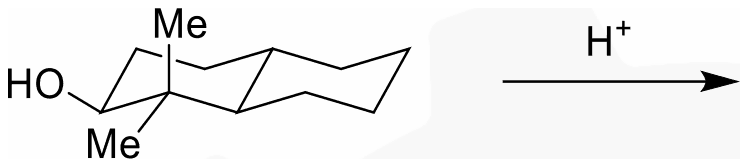
- A.
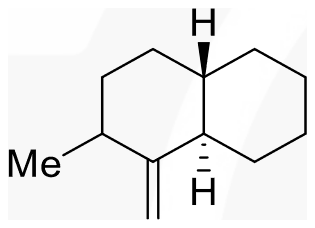
- B.
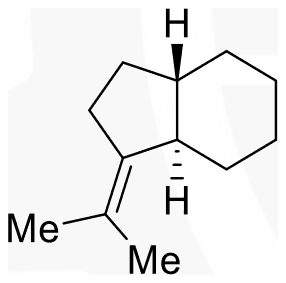
- C.
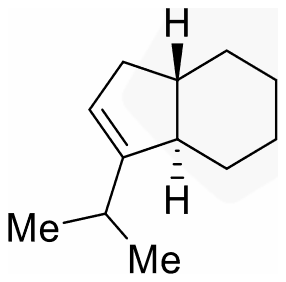
- D.
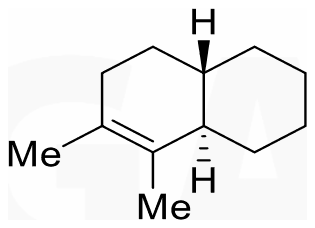
Answer: B
The major product is (B), the hydrindane carrying an exocyclic isopropylidene group.
Acid protonates the OH and water leaves, giving a secondary carbocation next to the quaternary CMe2 carbon. In the rigid trans-decalin the OH is equatorial, and the group antiperiplanar to an equatorial leaving group is a ring C-C bond, not the axial methyl. So the ring bond from the CMe2 carbon to the ring-fusion carbon migrates to the cationic centre (a Wagner-Meerwein shift).
That migration contracts the six-membered ring to a five-membered one and leaves the positive charge on the CMe2 carbon, now outside the ring: a stable tertiary cation. Loss of a proton from the ring carbon gives the tetrasubstituted exocyclic alkene, the isopropylidene hydrindane (B). The trans ring fusion is untouched.
(A) and (D) keep the six-membered ring and would come from methyl migration, which needs the methyl antiperiplanar to the leaving group (an axial OH). (C), with the isopropyl group on an endocyclic alkene, is the less substituted alkene from the same cation, not the major product.
Post your comment
Please log in or register to post a comment.
Examination Categories
- SSC Exams
- Banking Exams
- Teaching Exams
- Civil Services Exams
- Railways Exams
- Engineering Recruitment Exams
- Defence Exams
- State Government Exams
- Police Exams
- Insurance Exams
- Nursing Exams
- Other Government Exams
- NRA CET
- PG Entrance Exams
- Campus Placement
- MBA Entrance Exams
- CUET and UG Entrance
- Judiciary Exams
- Regulatory Body Exams
- Software Development