
Discussion
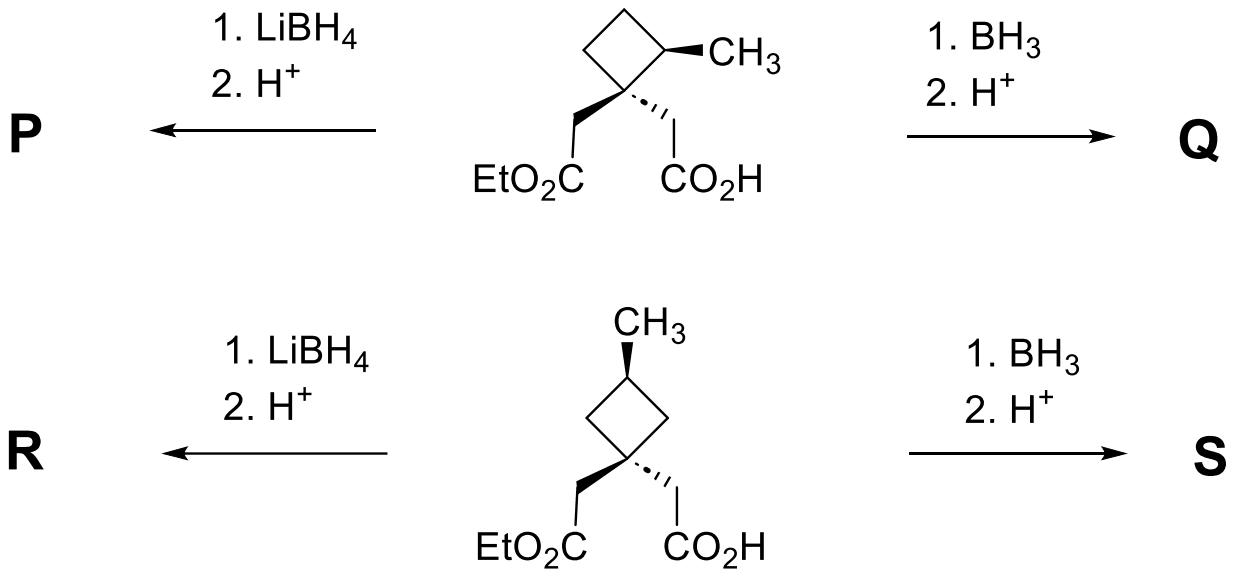
Considering LiBH4 reduces an ester group to the corresponding alcohol and does not reduce a carboxylic acid group, the correct statement about the major products P, Q, R and S is
Answer: C
The correct statement is (C): P and Q are diastereomers, and R and S are diastereomers.
The starting material has two arms on one ring carbon: \(CH_{2}CO_{2}Et\) and \(CH_{2}CO_{2}H\). LiBH4 reduces the ester arm to \(CH_{2}CH_{2}OH\) and leaves the acid; BH3 reduces the acid arm to \(CH_{2}CH_{2}OH\) and leaves the ester. On the acidic workup, each hydroxy acid or hydroxy ester closes to the same kind of six-membered lactone, a spiro compound in which a \(CH_{2}C(=O)O\) arm and a \(CH_{2}CH_{2}O\) arm are joined at the ring carbon. This is the reading that makes the question well formed: without ring closure, P (a hydroxy acid) and Q (a hydroxy ester) would not even be isomers.
In P the carbonyl arm is the one that was drawn hashed; in Q it is the one that was drawn bold. So at the spiro carbon P and Q differ in configuration while the methyl-bearing carbon is unchanged: they are diastereomers. In the second starting material the methyl group is opposite the spiro carbon, so the carbonyl arm of R is trans (hashed) and that of S is cis (bold) to the methyl group: again diastereomers. Options (A), (B) and (D) each call at least one of the pairs identical.
Post your comment
Please log in or register to post a comment.
Examination Categories
- SSC Exams
- Banking Exams
- Teaching Exams
- Civil Services Exams
- Railways Exams
- Engineering Recruitment Exams
- Defence Exams
- State Government Exams
- Police Exams
- Insurance Exams
- Nursing Exams
- Other Government Exams
- NRA CET
- PG Entrance Exams
- Campus Placement
- MBA Entrance Exams
- CUET and UG Entrance
- Judiciary Exams
- Regulatory Body Exams
- Software Development