
Discussion
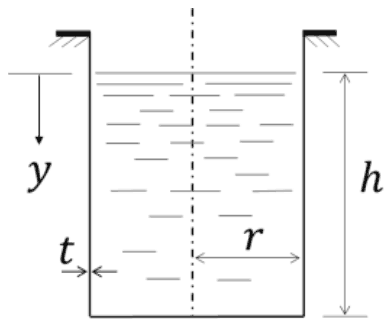
The figure shows a thin-walled open-top cylindrical vessel of radius \(r\) and wall thickness \(t\). The vessel is held along the brim and contains a constant-density liquid to height \(h\) from the base. Neglect atmospheric pressure, the weight of the vessel and bending stresses in the vessel walls.
Which one of the plots depicts qualitatively CORRECT dependence of the magnitudes of axial wall stress (\(\sigma_{1}\)) and circumferential wall stress (\(\sigma_{2}\)) on \(y\)?
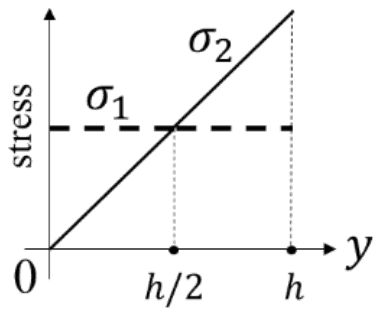
- A.
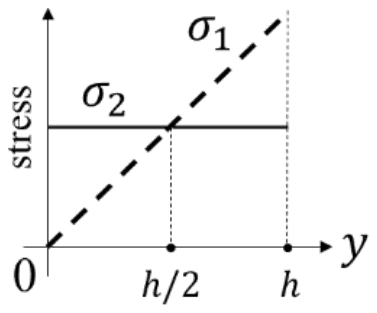
- B.
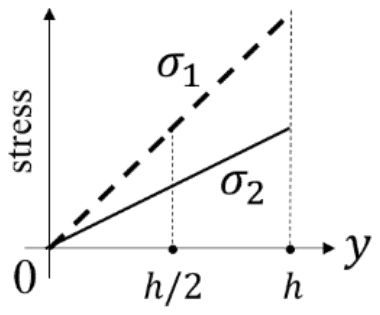
- C.
- D.
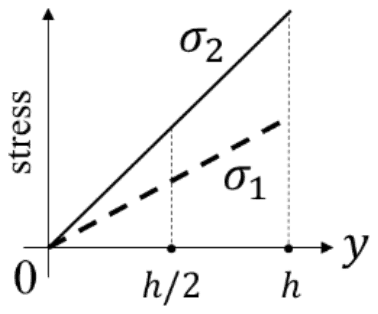
Answer: A
The correct plot is (A): \(\sigma_{1}\) constant, \(\sigma_{2}\) rising linearly from zero and equal to \(\sigma_{1}\) at \(y = h/2\).
With \(y\) measured down from the liquid surface, the pressure at depth \(y\) is \(\rho g y\). The hoop (circumferential) stress of a thin cylinder is
\[ \sigma_{2} = \frac{pr}{t} = \frac{\rho g y\, r}{t} \]
which is zero at the surface and grows linearly with depth. Pressure on the vertical walls acts horizontally, so the only vertical load is the liquid's weight pressing on the base, \(\rho g h \cdot \pi r^{2}\). Hanging from the brim, every section of the wall carries that same load:
\[ \begin{aligned} \sigma_{1} &= \frac{\rho g h\,\pi r^{2}}{2\pi r t} \\ &= \frac{\rho g h\, r}{2t} \end{aligned} \]
which does not depend on \(y\). Setting \(\sigma_{2} = \sigma_{1}\) gives \(y = h/2\), and at the base \(\sigma_{2} = 2\sigma_{1}\), exactly as plot (A) shows. (B) swaps the two stresses. (C) and (D) make the axial stress grow with depth, which would need the wall load to change along its height.
Post your comment
Please log in or register to post a comment.
Examination Categories
- SSC Exams
- Banking Exams
- Teaching Exams
- Civil Services Exams
- Railways Exams
- Engineering Recruitment Exams
- Defence Exams
- State Government Exams
- Police Exams
- Insurance Exams
- Nursing Exams
- Other Government Exams
- NRA CET
- PG Entrance Exams
- Campus Placement
- MBA Entrance Exams
- CUET and UG Entrance
- Judiciary Exams
- Regulatory Body Exams
- Software Development