
Discussion
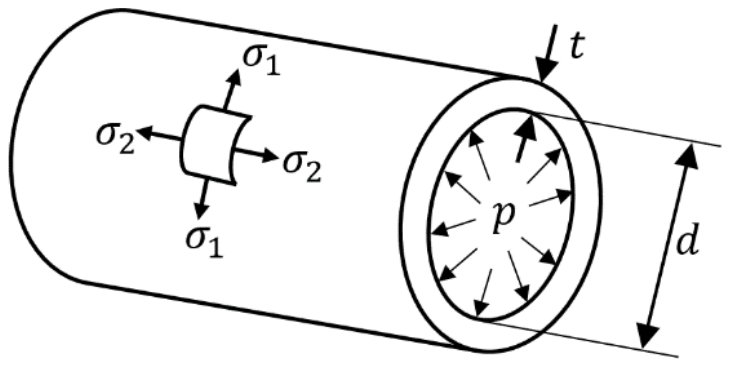
A thin walled, closed cylindrical vessel of inside diameter \(d\) and wall thickness \(t\) contains a fluid under pressure \(p\). The figure below shows a part of the cylindrical vessel; end caps are not shown. Consider the small element shown with sides parallel and perpendicular to the axis of the cylinder. The stresses \(\sigma_{1}\) and \(\sigma_{2}\) are
Answer: A
The stresses are \(\sigma_{1} = \frac{pd}{2t}\); \(\sigma_{2} = \frac{pd}{4t}\).
\(\sigma_{1}\) is the hoop (circumferential) stress. Cutting a length \(\ell\) of the cylinder along a diameter, the pressure force \(p d \ell\) is resisted by two walls of area \(t\ell\): \(\sigma_{1} = \frac{pd}{2t}\).
\(\sigma_{2}\) is the longitudinal stress, set up because the ends are closed. The pressure on the end, \(p\frac{\pi d^{2}}{4}\), is carried by the wall ring of area about \(\pi d t\): \(\sigma_{2} = \frac{pd}{4t}\), half the hoop stress.
The option with \(\sigma_{1}\) and \(\sigma_{2}\) swapped assigns the hoop stress to the axial direction. \(\frac{pd}{t}\) forgets that two walls share the hoop load, and \(\sigma_{2} = 0\) would hold only for an open-ended cylinder, but this vessel is closed.
Post your comment
Please log in or register to post a comment.
Examination Categories
- SSC Exams
- Banking Exams
- Teaching Exams
- Civil Services Exams
- Railways Exams
- Engineering Recruitment Exams
- Defence Exams
- State Government Exams
- Police Exams
- Insurance Exams
- Nursing Exams
- Other Government Exams
- NRA CET
- PG Entrance Exams
- Campus Placement
- MBA Entrance Exams
- CUET and UG Entrance
- Judiciary Exams
- Regulatory Body Exams
- Software Development