
Discussion
A long solenoid is carrying a time dependent current such that the magnetic field inside has the form \(\vec{B}(t) = B_{0} t^{2} \hat{k}\), where \(\hat{k}\) is along the axis of the solenoid. The displacement current at the point P on a circle of radius r in a plane perpendicular to the axis
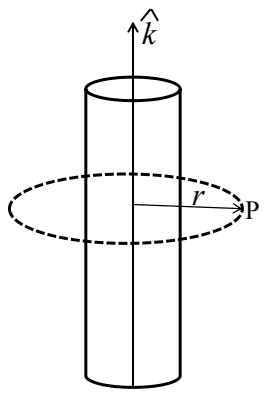
Answer: B
The displacement current at P is inversely proportional to r and tangential.
The changing flux inside the solenoid (radius a) induces a circulating electric field. Outside it, Faraday's law on a circle of radius r gives
\[ \begin{aligned} E \cdot 2\pi r &= -\frac{d}{dt}(B_{0}t^{2}\pi a^{2}) \\ E &= -\frac{B_{0} t\, a^{2}}{r} \end{aligned} \]
The displacement current density is \(\varepsilon_{0}\,\partial \vec{E}/\partial t = -\varepsilon_{0} B_{0} a^{2}/r\) along \(\hat{\phi}\): tangential, constant in time, and proportional to \(1/r\).
It is not radial, because the induced field circulates. It does not grow with time, because \(E\) is linear in \(t\) so its derivative is constant. The \(1/r^{2}\) option has the wrong dependence for a field produced by a fixed enclosed flux.
Post your comment
Please log in or register to post a comment.
Examination Categories
- SSC Exams
- Banking Exams
- Teaching Exams
- Civil Services Exams
- Railways Exams
- Engineering Recruitment Exams
- Defence Exams
- State Government Exams
- Police Exams
- Insurance Exams
- Nursing Exams
- Other Government Exams
- NRA CET
- PG Entrance Exams
- Campus Placement
- MBA Entrance Exams
- CUET and UG Entrance
- Judiciary Exams
- Regulatory Body Exams
- Software Development