
Discussion
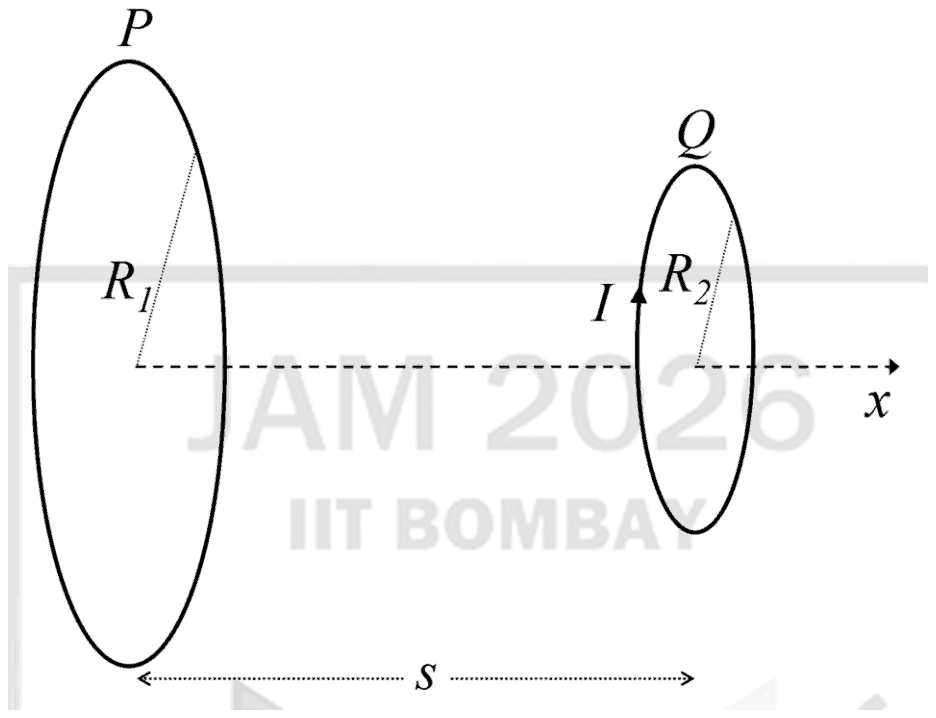
Two small circular copper loops P and Q of radii R1 and R2, respectively, are coaxially placed along the x-axis as shown in the figure. The loops are at a distance s apart, where s >> R1, R2. The loop Q carrying a steady current I is moving away along x-axis with a speed \(v\).
Which of the following statements is/are correct?
Answer: C
The correct statement is that the emf induced in loop P is \(\propto \frac{1}{s^4}\).
Because \(s\) is much larger than both radii, loop Q acts as a magnetic dipole \(m = I\pi R_2^2\), and its field on the axis at P falls off as the cube of the distance:
\[ \begin{aligned} B &= \frac{\mu_0 m}{2\pi s^{3}}, \quad \Phi_P \approx B\,\pi R_1^{2} \propto \frac{1}{s^{3}} \\ \varepsilon &= -\frac{d\Phi_P}{dt} = -\frac{d\Phi_P}{ds}\frac{ds}{dt} \propto \frac{v}{s^{4}} \end{aligned} \]
So the emf is proportional to \(1/s^4\) and to \(v\) to the first power.
The field at the centre of P goes as \(1/s^3\), not \(1/s^2\), and so does the flux, which rules out the first two statements. The emf is linear in \(v\), not proportional to \(v^2\).
Post your comment
Please log in or register to post a comment.
Examination Categories
- SSC Exams
- Banking Exams
- Teaching Exams
- Civil Services Exams
- Railways Exams
- Engineering Recruitment Exams
- Defence Exams
- State Government Exams
- Police Exams
- Insurance Exams
- Nursing Exams
- Other Government Exams
- NRA CET
- PG Entrance Exams
- Campus Placement
- MBA Entrance Exams
- CUET and UG Entrance
- Judiciary Exams
- Regulatory Body Exams
- Software Development