
Discussion
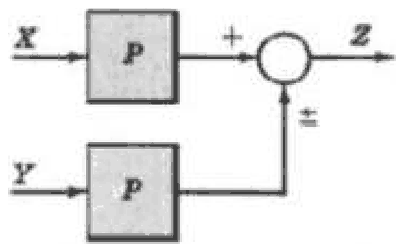
For the given block diagram, which of the following options is a correct replacement for moving a summing point ahead of a block?

- A.
- B.

- C.

- D.

Answer: B
The original diagram has the block \(P\) before the summing point: \(Z = PX \pm Y\). To move the summing point ahead of (before) the block, the signal \(Y\) that is added after \(P\) must be divided by \(P\) so that it has the same effect once it goes through the block.
\[ Z = P\left(X \pm \frac{Y}{P}\right) = PX \pm Y \]
So the correct replacement is to put the block \(1/P\) in the path of \(Y\), then sum with \(X\), and then pass the sum through \(P\), which is figure (B). In figure (A) the second \(P\) multiplies \(Y\) by \(P\), giving \(PX \pm PY\), which is wrong. In (C) the output is \(P(X \pm Y) \ne PX \pm Y\). Figure (D) is the rule for moving a take-off point, not a summing point. The answer is option B.
Post your comment
Please log in or register to post a comment.
Examination Categories
- SSC Exams
- Banking Exams
- Teaching Exams
- Civil Services Exams
- Railways Exams
- Engineering Recruitment Exams
- Defence Exams
- State Government Exams
- Police Exams
- Insurance Exams
- Nursing Exams
- Other Government Exams
- NRA CET
- PG Entrance Exams
- Campus Placement
- MBA Entrance Exams
- CUET and UG Entrance
- Judiciary Exams
- Regulatory Body Exams
- Software Development