
Discussion
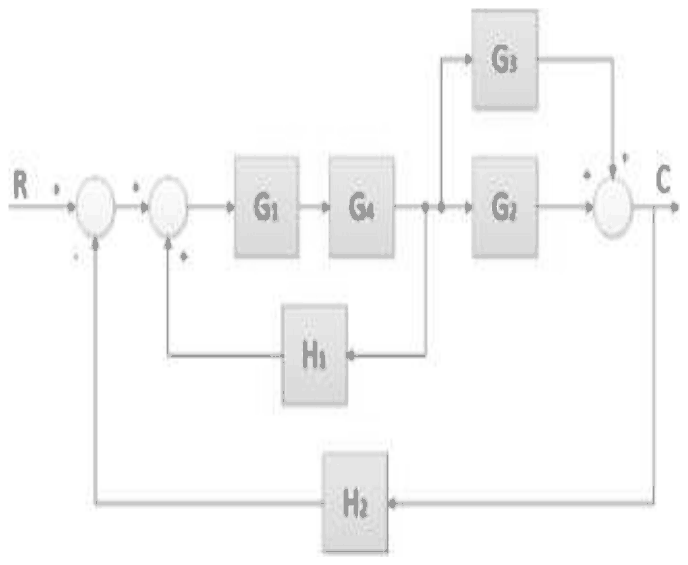
Which of the following options is the correct reduced block diagram (complete reduction) of the given block diagram?
- A.
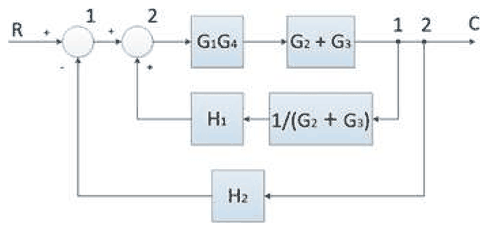
- B.
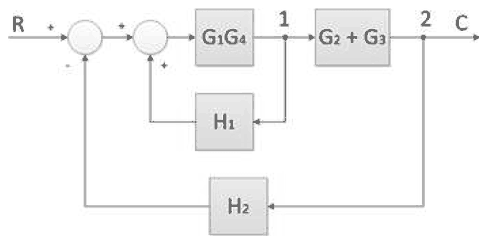
- C.
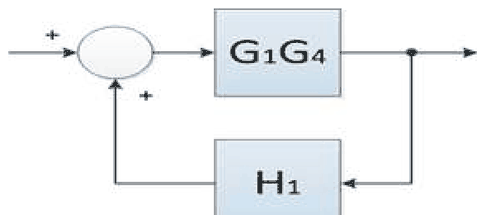
- D.
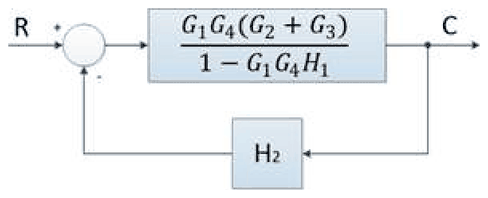
Answer: D
Reduce the diagram step by step. The blocks \(G_2\) and \(G_3\) are in parallel, so they combine to \(G_2 + G_3\), and the blocks \(G_1\) and \(G_4\) in series combine to \(G_1G_4\).
The feedback path \(H_1\) is taken from a point before the block \(G_2 + G_3\). Moving that take-off point after the block means that \(H_1\) must be divided by \(G_2 + G_3\), giving the inner loop with forward gain \(G_1G_4(G_2 + G_3)\) and feedback \(H_1/(G_2 + G_3)\), with positive feedback.
\[ \begin{aligned} \frac{G_1G_4(G_2 + G_3)}{1 - G_1G_4(G_2 + G_3)\cdot\dfrac{H_1}{G_2 + G_3}} \\ &= \frac{G_1G_4(G_2 + G_3)}{1 - G_1G_4H_1} \end{aligned} \]
This is a single block with the outer feedback \(H_2\) around it, which is figure (D). Figures (A) and (B) are intermediate stages, not the complete reduction, and (C) leaves out \(G_2 + G_3\) and \(H_2\). The answer is option D.
Post your comment
Please log in or register to post a comment.
Examination Categories
- SSC Exams
- Banking Exams
- Teaching Exams
- Civil Services Exams
- Railways Exams
- Engineering Recruitment Exams
- Defence Exams
- State Government Exams
- Police Exams
- Insurance Exams
- Nursing Exams
- Other Government Exams
- NRA CET
- PG Entrance Exams
- Campus Placement
- MBA Entrance Exams
- CUET and UG Entrance
- Judiciary Exams
- Regulatory Body Exams
- Software Development