
Discussion
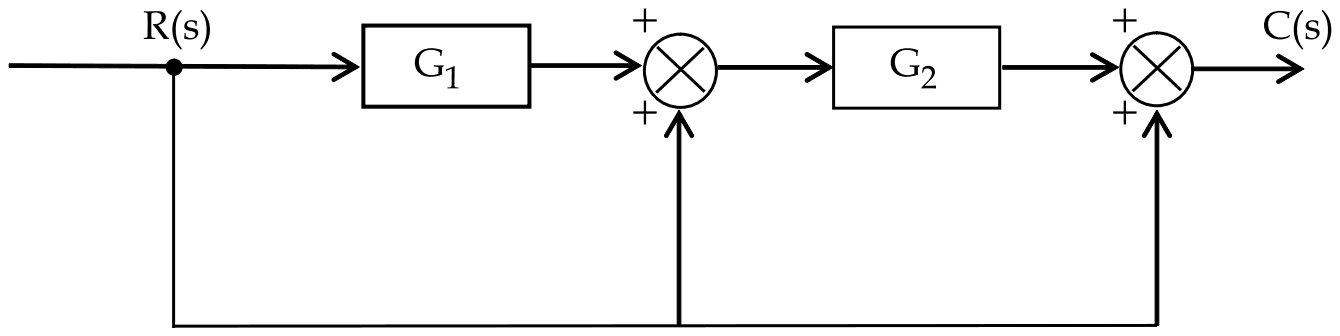
The transfer function \(\left(\frac{C(s)}{R(s)}\right)\) of the system shown in figure below is :
Answer: A
The transfer function is \(1 + G_{2} + G_{1}G_{2}\).
Follow the signal forward. The first summing point adds R(s) to the output of \(G_{1}\), so its output is \(R(1 + G_{1})\). This passes through \(G_{2}\), and the second summing point adds R(s) once more:
\[ \begin{aligned} C &= G_{2}R(1 + G_{1}) + R \\ &= R(1 + G_{2} + G_{1}G_{2}) \end{aligned} \]
There is no feedback loop, only feedforward paths, so the result has no denominator, which rules out the two fractional options. \(1 + G_{1} + G_{2} + G_{1}G_{2}\) would need a direct path through \(G_{1}\) alone to the output, which the diagram does not have.
Post your comment
Please log in or register to post a comment.
Examination Categories
- SSC Exams
- Banking Exams
- Teaching Exams
- Civil Services Exams
- Railways Exams
- Engineering Recruitment Exams
- Defence Exams
- State Government Exams
- Police Exams
- Insurance Exams
- Nursing Exams
- Other Government Exams
- NRA CET
- PG Entrance Exams
- Campus Placement
- MBA Entrance Exams
- CUET and UG Entrance
- Judiciary Exams
- Regulatory Body Exams
- Software Development