
Discussion
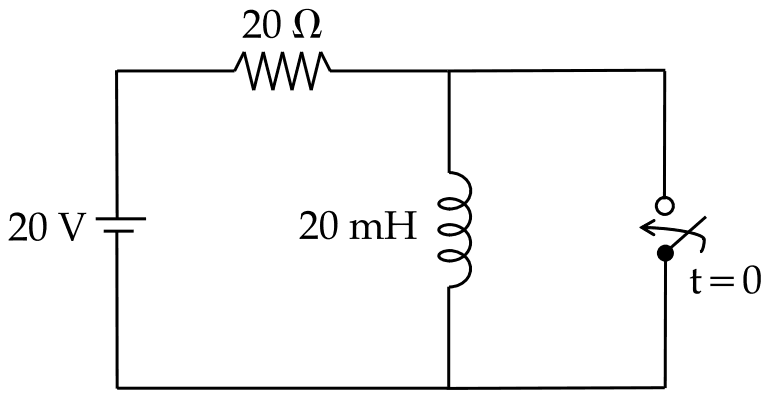
A circuit is shown in figure is in steady state, when switched on at t = 0. Assuming that the inductance is ideal, the current through inductor at t = 0+ equals :
Answer: B
The inductor current at \(t = 0^{+}\) is 1 A.
Before the switch operates the circuit is in steady state, and an ideal inductor carrying direct current behaves as a short circuit. So the whole 20 V appears across the 20 Ω resistor:
\[ i_{L}(0^{-}) = \frac{20}{20} = 1\ \text{A} \]
The current through an inductor cannot change instantaneously, because that would need infinite voltage, so \(i_{L}(0^{+}) = i_{L}(0^{-}) = 1\) A. Closing the switch across the inductor only lets that current circulate through the switch, where it stays in the ideal case.
0 A ignores the continuity of inductor current, and 0.5 A or 2 A do not follow from the circuit values.
Post your comment
Please log in or register to post a comment.
Examination Categories
- SSC Exams
- Banking Exams
- Teaching Exams
- Civil Services Exams
- Railways Exams
- Engineering Recruitment Exams
- Defence Exams
- State Government Exams
- Police Exams
- Insurance Exams
- Nursing Exams
- Other Government Exams
- NRA CET
- PG Entrance Exams
- Campus Placement
- MBA Entrance Exams
- CUET and UG Entrance
- Judiciary Exams
- Regulatory Body Exams
- Software Development