
Discussion
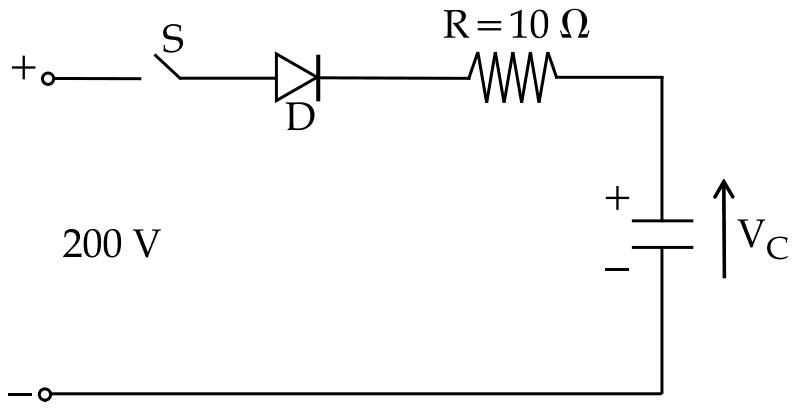
In figure given below, capacitor 'C' is charged to V0 = 100 V with upper plate positive. At time t = 0, switch S is closed. Current through the circuit at t = 0 and final voltage across 'C' are __________.
Answer: B
The current at \(t = 0\) is 10 A and the final capacitor voltage is 200 V.
At the instant the switch closes, the capacitor already holds 100 V opposing the 200 V source, and the diode is forward biased because the source is the higher. The net voltage drives the current through R:
\[ i(0) = \frac{200 - 100}{10} = 10\ \text{A} \]
The capacitor then charges until its voltage equals the source voltage, 200 V, at which point the current falls to zero; the diode stops it from reversing. 20 A ignores the initial charge on the capacitor, and 150 V is only the average of the two voltages, not where the charging stops.
Post your comment
Please log in or register to post a comment.
Examination Categories
- SSC Exams
- Banking Exams
- Teaching Exams
- Civil Services Exams
- Railways Exams
- Engineering Recruitment Exams
- Defence Exams
- State Government Exams
- Police Exams
- Insurance Exams
- Nursing Exams
- Other Government Exams
- NRA CET
- PG Entrance Exams
- Campus Placement
- MBA Entrance Exams
- CUET and UG Entrance
- Judiciary Exams
- Regulatory Body Exams
- Software Development