
Discussion
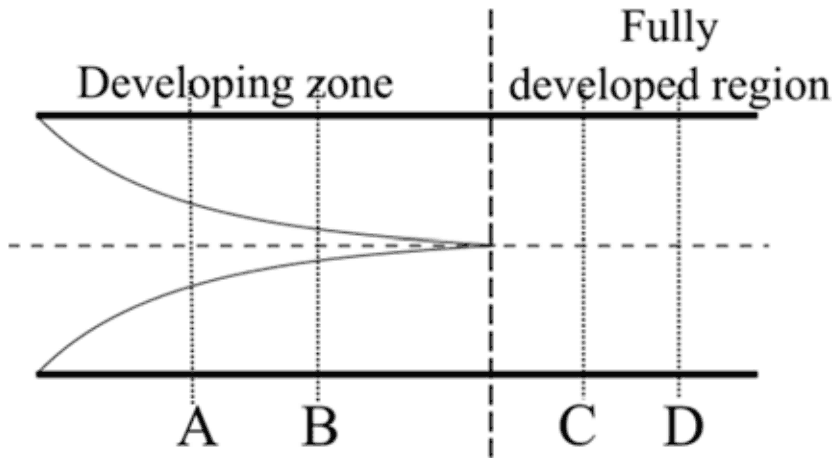
The figure shows the developing zone and the fully developed region in a pipe flow where the steady flow takes place from left to right. The wall shear stress in the sections A, B, C, and D are given by \(\tau_{A}, \tau_{B}, \tau_{C}\), and \(\tau_{D}\), respectively. Select the correct statement.
Answer: A
The correct statement is \(\tau_{A} \gt \tau_{B}\).
At the pipe entrance the boundary layer is very thin, so the velocity gradient at the wall, and with it the wall shear stress \(\tau = \mu (du/dy)_{wall}\), is large. As the boundary layer thickens along the developing zone the wall gradient falls, so the shear stress decreases with distance: section A, upstream of B, has the larger value.
Once the flow is fully developed the velocity profile no longer changes along the pipe, so the wall shear stress is constant: \(\tau_{C} = \tau_{D}\), which rules out \(\tau_{C} \gt \tau_{D}\). The fully developed value is the lowest along the pipe, so \(\tau_{C} \gt \tau_{B}\) is also wrong, as is \(\tau_{B} \gt \tau_{A}\).
Post your comment
Please log in or register to post a comment.
Examination Categories
- SSC Exams
- Banking Exams
- Teaching Exams
- Civil Services Exams
- Railways Exams
- Engineering Recruitment Exams
- Defence Exams
- State Government Exams
- Police Exams
- Insurance Exams
- Nursing Exams
- Other Government Exams
- NRA CET
- PG Entrance Exams
- Campus Placement
- MBA Entrance Exams
- CUET and UG Entrance
- Judiciary Exams
- Regulatory Body Exams
- Software Development