
Discussion
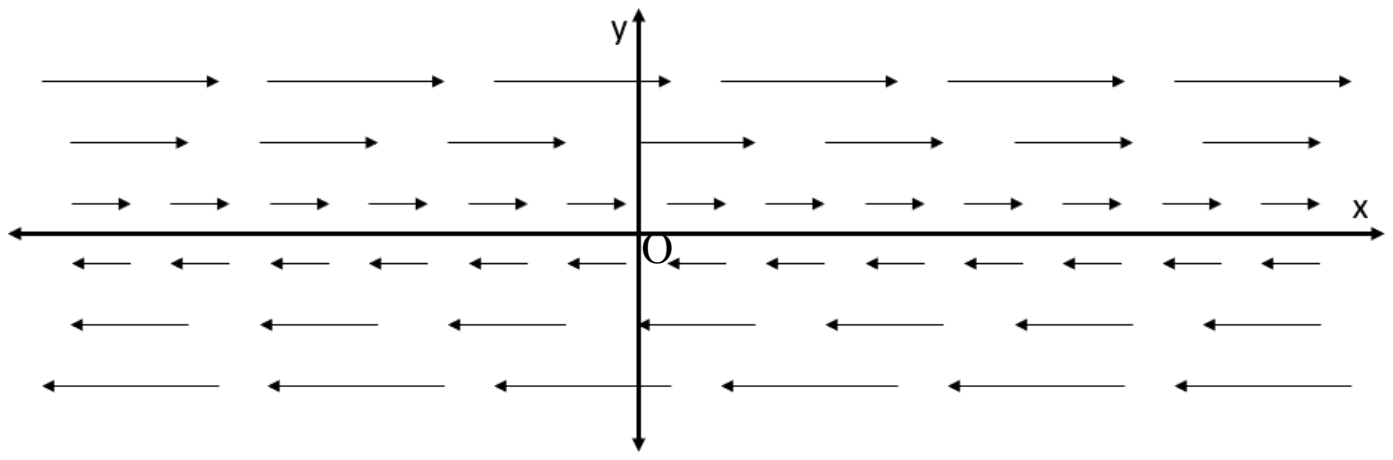
Sketch of a two-dimensional vector field \(\vec{V}\) is shown below. Here, length and arrow head of the arrows denote magnitude and direction of the vector field, respectively. Which of the following statements is correct for \(\vec{\nabla} \times \vec{V}\) ?
Answer: C
The curl is non-zero and points into the plane.
The sketch shows a shear field: \(\vec{V} = V_{x}(y)\hat{x}\), with \(V_{x}\) positive above the x axis, negative below it, and growing with \(|y|\). Take it as \(V_{x} = ky\) with k > 0. Then
\[ \begin{aligned} \vec{\nabla} \times \vec{V} &= \left(\frac{\partial V_{y}}{\partial x} - \frac{\partial V_{x}}{\partial y}\right)\hat{z} \\ &= (0 - k)\hat{z} = -k\hat{z} \end{aligned} \]
With x to the right and y up, \(-\hat{z}\) points into the page. A paddle wheel placed anywhere would turn clockwise, because the flow above it is faster to the right than the flow below. The curl is the same everywhere, so it is not zero and does not reverse across the x axis, and its direction is into, not out of, the plane.
Post your comment
Please log in or register to post a comment.
Examination Categories
- SSC Exams
- Banking Exams
- Teaching Exams
- Civil Services Exams
- Railways Exams
- Engineering Recruitment Exams
- Defence Exams
- State Government Exams
- Police Exams
- Insurance Exams
- Nursing Exams
- Other Government Exams
- NRA CET
- PG Entrance Exams
- Campus Placement
- MBA Entrance Exams
- CUET and UG Entrance
- Judiciary Exams
- Regulatory Body Exams
- Software Development