
Discussion
Consider the electrostatic potential in two dimensions \(V(x,y) = x^{8}y^{9}\). What is the line integral of the corresponding electric field along the path shown in the figure?
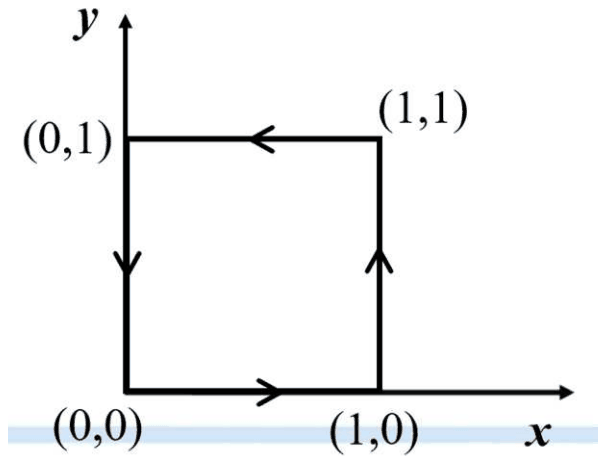
Answer: A
The line integral is 0.
An electrostatic field is the negative gradient of a potential, \(\vec{E} = -\nabla V\), so its line integral between two points depends only on the end points:
\[ \int_a^b \vec{E} \cdot d\vec{l} = V(a) - V(b) \]
The path in the figure is closed: it starts and ends at (0,0). So the integral is \(V(0,0) - V(0,0) = 0\), whatever the form of \(V\). Equivalently, \(\nabla \times \vec{E} = 0\), so by Stokes' theorem the circulation round any loop vanishes.
The specific powers \(x^8y^9\) are a distraction. The values 1, 2 and 1/2 would need a non-conservative field, or come from integrating only part of the loop: along the side from (1,0) to (1,1) alone, the integral is \(V(1,0) - V(1,1) = -1\).
Post your comment
Please log in or register to post a comment.
Examination Categories
- SSC Exams
- Banking Exams
- Teaching Exams
- Civil Services Exams
- Railways Exams
- Engineering Recruitment Exams
- Defence Exams
- State Government Exams
- Police Exams
- Insurance Exams
- Nursing Exams
- Other Government Exams
- NRA CET
- PG Entrance Exams
- Campus Placement
- MBA Entrance Exams
- CUET and UG Entrance
- Judiciary Exams
- Regulatory Body Exams
- Software Development