
Discussion
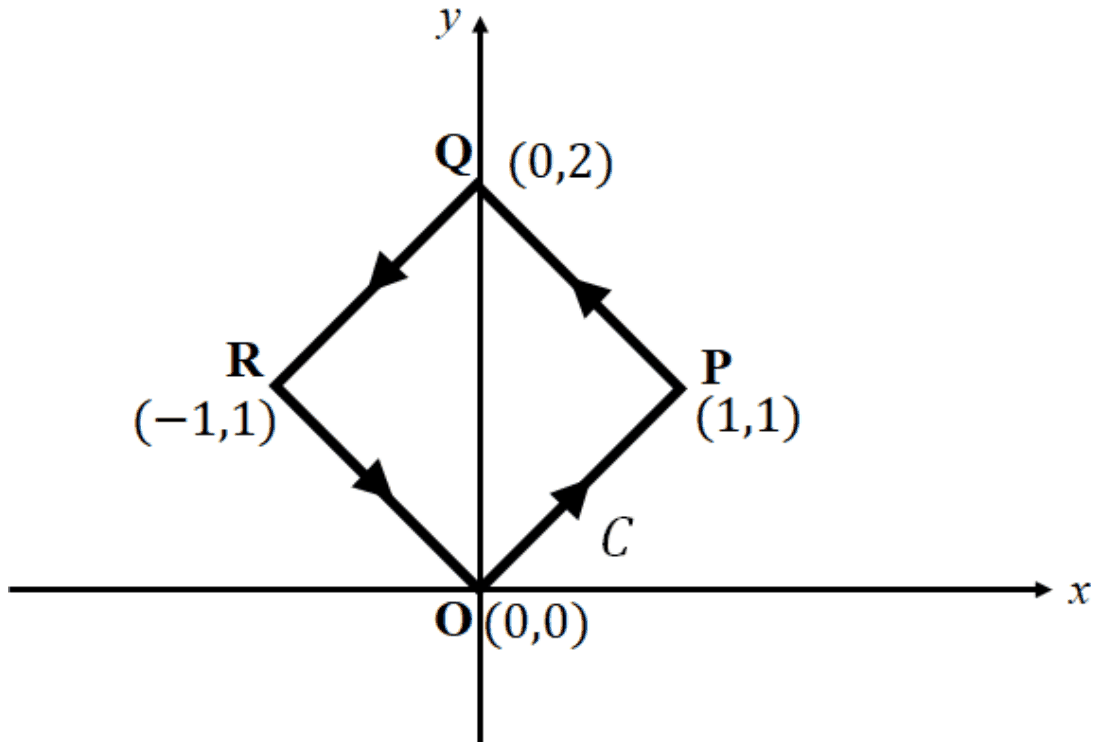
Consider the contour \(C\) shown in the figure below. For the vector \(\vec{F} = (x + 2y)\hat{e}_x + (2x + 4y)\hat{e}_y\), the integral \(\oint_C \vec{F} \cdot d\vec{l}\) =________.
Here \(d\vec{l}\) represents an infinitesimal length along the contour \(C\).
Answer: A
The integral is 0.
The field is conservative. Its curl (the z-component, for a plane field) is
\[ \begin{aligned} &\frac{\partial F_y}{\partial x} - \frac{\partial F_x}{\partial y} \\ &= 2 - 2 = 0 \end{aligned} \]
Indeed \(\vec{F} = \nabla \phi\) with \(\phi = \tfrac{1}{2}x^{2} + 2xy + 2y^{2}\). By Stokes' (or Green's) theorem the circulation of a curl-free field round any closed contour is zero, whatever the shape or direction of the contour.
By Green's theorem the circulation equals the curl integrated over the enclosed area. The square has diagonals of length 2 and so an area of 2, which is what a curl of 1 would give; with a curl of zero, 2, 4 and 6 are all impossible. The integral along each single side is not zero (from O to P it is \(\phi(P) - \phi(O) = 4.5\)), but the four sides cancel.
Post your comment
Please log in or register to post a comment.
Examination Categories
- SSC Exams
- Banking Exams
- Teaching Exams
- Civil Services Exams
- Railways Exams
- Engineering Recruitment Exams
- Defence Exams
- State Government Exams
- Police Exams
- Insurance Exams
- Nursing Exams
- Other Government Exams
- NRA CET
- PG Entrance Exams
- Campus Placement
- MBA Entrance Exams
- CUET and UG Entrance
- Judiciary Exams
- Regulatory Body Exams
- Software Development