
Discussion
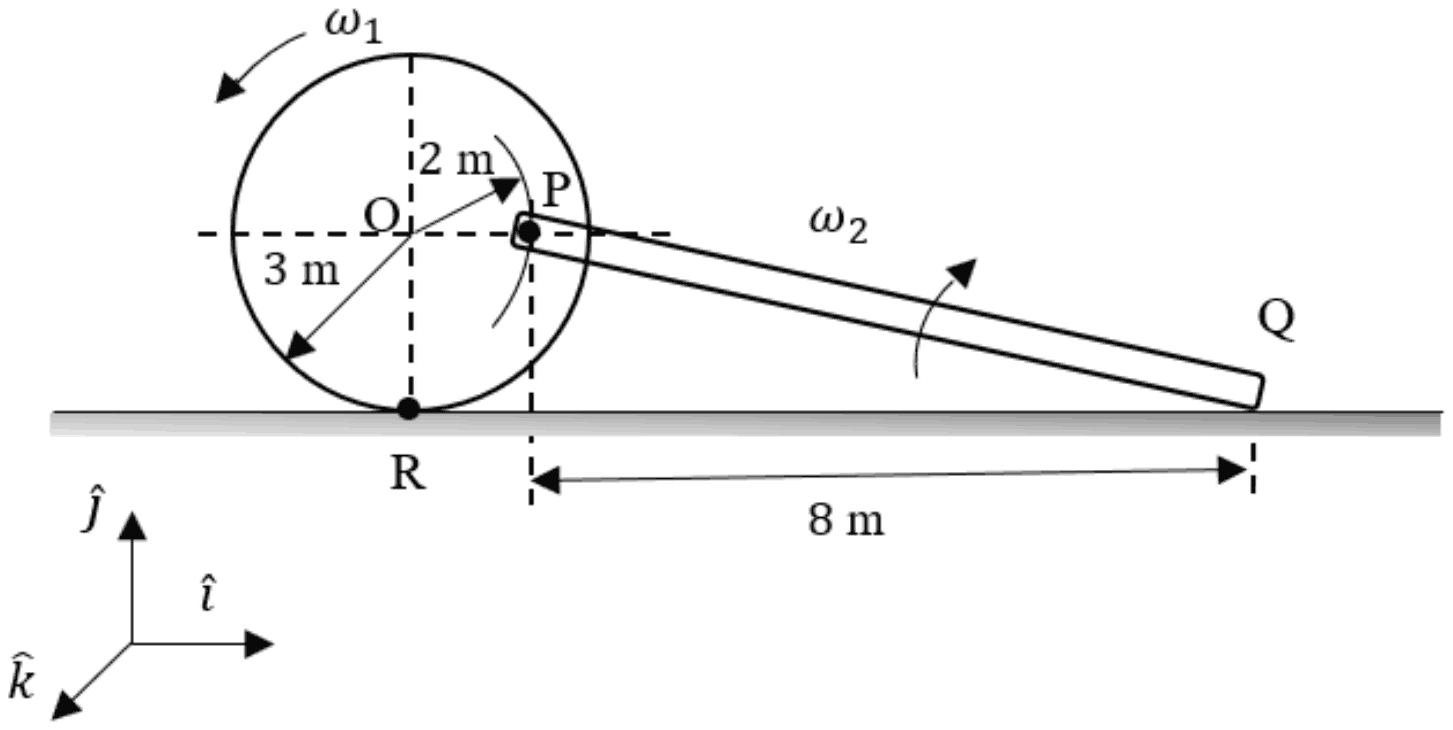
The figure shows a wheel rolling without slipping on a horizontal plane with angular velocity \(\omega_{1}\). A rigid bar PQ is pinned to the wheel at P while the end Q slides on the floor.
What is the angular velocity \(\omega_{2}\) of the bar PQ?
Answer: D
The angular velocity of the bar is \(\omega_{2} = 0.25\omega_{1}\).
Rolling without slipping makes the contact point R the instantaneous centre of the wheel. Take R as the origin: O is at (0, 3) and P, 2 m from O along the horizontal through O, is at (2, 3). So
\[ \begin{aligned} v_{P} &= \omega_{1}\,RP = \omega_{1}\sqrt{2^{2} + 3^{2}} \\ &= \sqrt{13}\,\omega_{1} \end{aligned} \]
and \(v_{P}\) is perpendicular to RP. Q, 8 m to the right of P, is at (10, 0) and slides along the floor, so its velocity is horizontal. The instantaneous centre I of the bar lies on the normal to each velocity: on the line RP extended, and on the vertical through Q. The line RP is \(y = 1.5x\), so at \(x = 10\) it gives I = (10, 15).
\[ \begin{aligned} IP &= \sqrt{8^{2} + 12^{2}} = 4\sqrt{13} \\ \omega_{2} &= \frac{v_{P}}{IP} \\ &= \frac{\sqrt{13}\,\omega_{1}}{4\sqrt{13}} \\ &= 0.25\,\omega_{1} \end{aligned} \]
The ratio is fixed by the geometry alone: the bar's centre I is four times as far from P as the wheel's centre R is, so the bar turns at a quarter of the wheel's rate. \(\omega_{2} = \omega_{1}\) would need the two centres equally far from P, and \(2\omega_{1}\) and \(0.5\omega_{1}\) do not match the distances in the figure.
Post your comment
Please log in or register to post a comment.
Examination Categories
- SSC Exams
- Banking Exams
- Teaching Exams
- Civil Services Exams
- Railways Exams
- Engineering Recruitment Exams
- Defence Exams
- State Government Exams
- Police Exams
- Insurance Exams
- Nursing Exams
- Other Government Exams
- NRA CET
- PG Entrance Exams
- Campus Placement
- MBA Entrance Exams
- CUET and UG Entrance
- Judiciary Exams
- Regulatory Body Exams
- Software Development