
Discussion
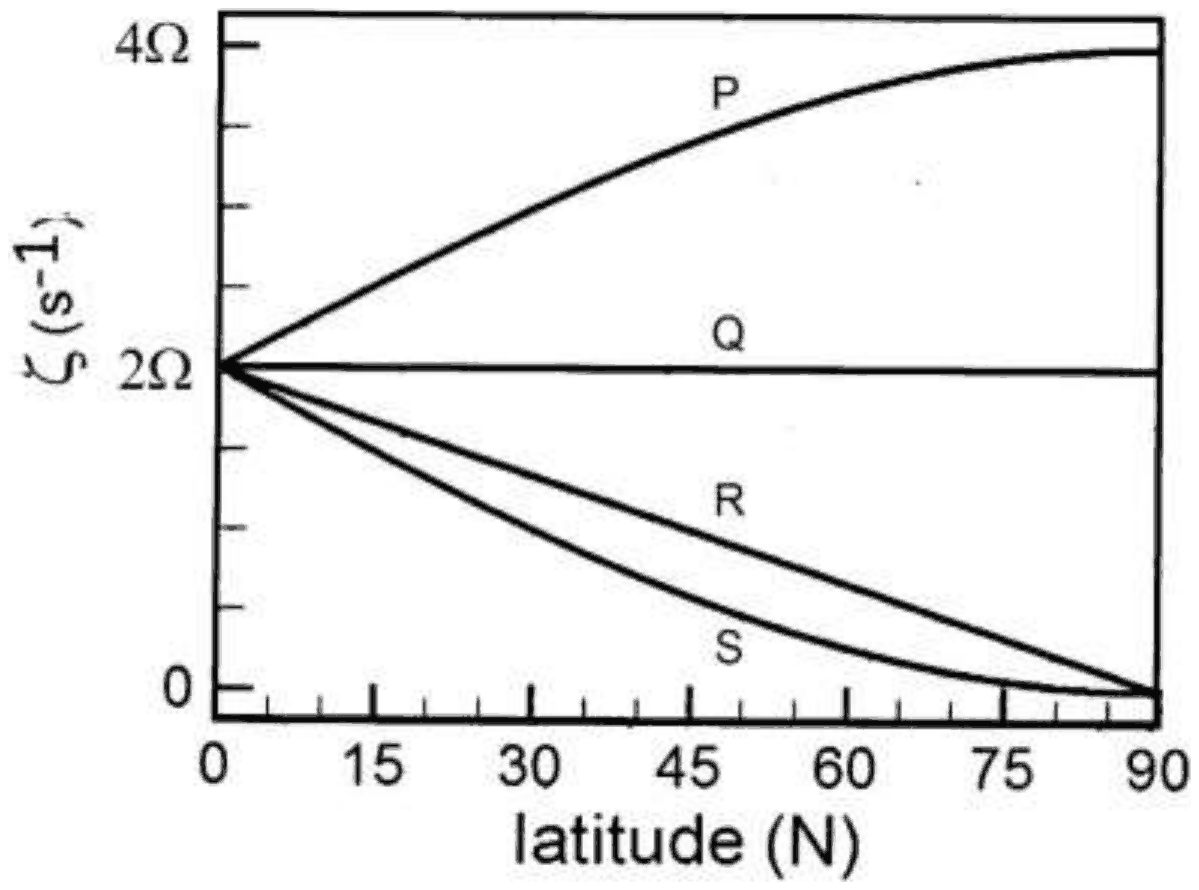
For an inviscid and barotropic ocean of constant depth (D), a water parcel with initial vorticity 2Ω is displaced from the equator to the north pole. Latitudinal variation of the parcel vorticity (ζ) is well represented by the curve
Answer: A
The curve is S.
For an inviscid barotropic ocean of constant depth, potential vorticity conservation reduces to conservation of absolute vorticity, \(\zeta + f\), where \(f = 2\Omega\sin\phi\). At the equator f = 0, so \(\zeta + f = 2\Omega\) throughout, and
\[ \zeta = 2\Omega(1 - \sin\phi) \]
This falls from \(2\Omega\) at the equator to 0 at the pole. It falls fastest near the equator, where \(\sin\phi\) grows quickly, and flattens near the pole, so it bends below the straight line: curve S.
R falls linearly with latitude, which would need \(\sin\phi\) to grow uniformly. Q keeps the relative vorticity constant, ignoring the change in f, and P adds f instead of subtracting it.
Post your comment
Please log in or register to post a comment.
Examination Categories
- SSC Exams
- Banking Exams
- Teaching Exams
- Civil Services Exams
- Railways Exams
- Engineering Recruitment Exams
- Defence Exams
- State Government Exams
- Police Exams
- Insurance Exams
- Nursing Exams
- Other Government Exams
- NRA CET
- PG Entrance Exams
- Campus Placement
- MBA Entrance Exams
- CUET and UG Entrance
- Judiciary Exams
- Regulatory Body Exams
- Software Development