
Discussion
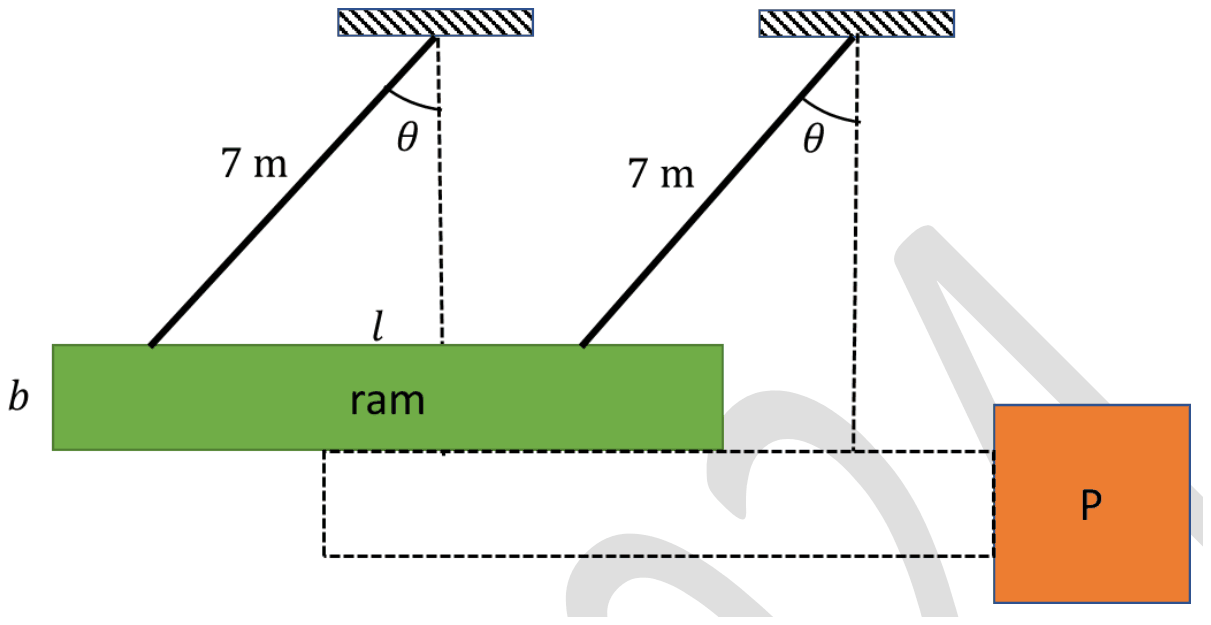
A ram in the form of a rectangular body of size \(l = 9\) m and \(b = 2\) m is suspended by two parallel ropes of lengths 7 m. Assume the center-of-mass of the body is at its geometric center and \(g = 9.81\) m/s2. For striking the object P with a horizontal velocity of 5 m/s, what is the angle \(\theta\) with the vertical from which the ram should be released from rest?
Answer: C
The ram should be released from 35.1°.
Because the two ropes are equal and parallel, the ram does not rotate: it moves in curvilinear translation, every point travelling on a circle of radius 7 m. Its size (9 m by 2 m) therefore does not enter. When released from angle \(\theta\), its centre of mass falls by \(7(1 - \cos\theta)\), and energy conservation gives the speed at the bottom:
\[ \begin{aligned} v^{2} &= 2gL(1 - \cos\theta) \\ 1 - \cos\theta &= \frac{25}{2 \times 9.81 \times 7} = 0.1820 \\ \cos\theta &= 0.8180 \Rightarrow \theta = 35.1^{\circ} \end{aligned} \]
The larger angles would give striking speeds well above 5 m/s; for example 67.1° corresponds to about 9.2 m/s.
Post your comment
Please log in or register to post a comment.
Examination Categories
- SSC Exams
- Banking Exams
- Teaching Exams
- Civil Services Exams
- Railways Exams
- Engineering Recruitment Exams
- Defence Exams
- State Government Exams
- Police Exams
- Insurance Exams
- Nursing Exams
- Other Government Exams
- NRA CET
- PG Entrance Exams
- Campus Placement
- MBA Entrance Exams
- CUET and UG Entrance
- Judiciary Exams
- Regulatory Body Exams
- Software Development